


Small Business Vehicle Purchases Slip as Owners Pull Back on Expansion
New NFIB survey data shows fewer small businesses purchasing or leasing vehicles as inflation, hiring challenges, and borrowing costs weigh on expansion plans.

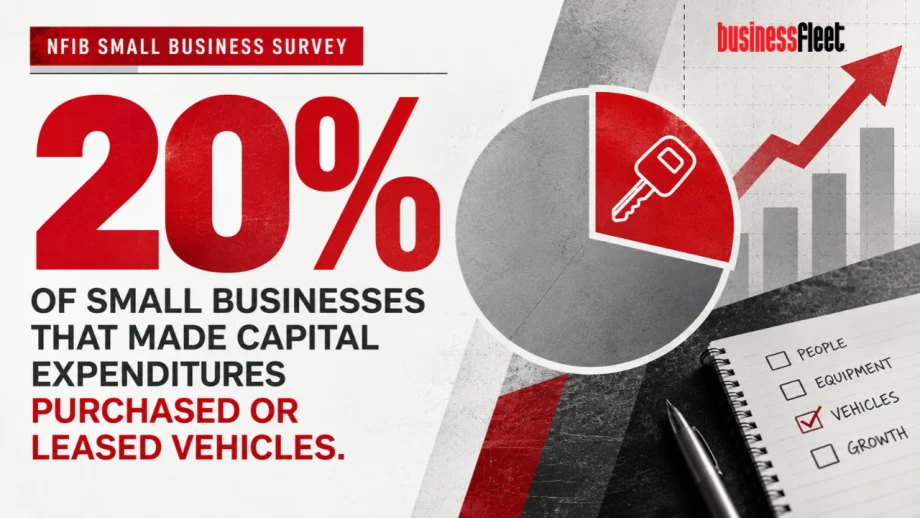
Vehicle purchasing and leasing activity among small businesses declined, with 20% of owners who made capital expenditures reporting vehicle acquisitions in the past six months, down from 22% a year earlier and 23% two years ago, according to NFIB's September 2026 Small Business Economic Trends report.
Business Fleet | This image was edited using OpenAI. Please refer to our terms of use.
- NFIB survey data reveals a decline in vehicle purchases or leases by small businesses.
- Challenges such as inflation, difficulties in hiring, and rising borrowing costs impact expansion efforts.
- Economic pressures lead small business owners to hesitate on expanding their operations.
*Summarized by AI
Small-business owners are taking a more cautious approach to expansion, and vehicle purchases are showing signs of slowing alongside broader business investment.
According to the National Federation of Independent Business (NFIB), 20% of small-business owners who made capital expenditures in the past six months reported purchasing or leasing vehicles. That's down from 22% a year earlier and 23% two years ago.
The findings are part of NFIB's September 2026 Small Business Economic Trends report, released October 13, which found that business optimism slipped as owners continued to face hiring challenges, inflation, and higher borrowing costs.
The NFIB Small Business Optimism Index declined 0.8 points to 97.9, just below its 52-year average of 98.0. The Uncertainty Index increased one point to 90, well above its historical average of 68.
“Small business optimism stayed near the long-term average in September as Main Street owners remain uncertain about business conditions,” said NFIB Chief Economist Bill Dunkelberg. “Small business owners are proceeding with caution as they interpret how rising costs, interest rates, and the difficulty in finding qualified employees are impacting their business.”
Vehicle Purchases and Capital Spending Slow
Vehicle purchasing is one part of a broader slowdown in small-business capital investment. Overall, 51% of small-business owners reported making capital expenditures during the previous six months, down two percentage points from August.
Among those making investments, 32% purchased new equipment, while 20% acquired vehicles and 16% improved or expanded their facilities.
Looking ahead, a seasonally adjusted 22% of owners plan to make capital expenditures over the next six months, down two points from August. Only 7% of owners said September was a good time to expand their business, a five-point decline from the previous month.
For businesses that depend on vehicles for deliveries, service calls, construction, or other daily operations, those investment decisions can affect how fleets are maintained and when vehicles are replaced.
Delaying a vehicle purchase may help preserve cash in the short term, but keeping an aging vehicle in service can also bring additional maintenance expenses and downtime. The decision often comes down to whether the existing vehicle can continue meeting the needs of the business.
Fuel and Operating Costs Continue to Pressure Profits
Inflation remained the second-largest concern among small-business owners in September, with 20% identifying it as their single most important problem, up four points from August.
For businesses operating vehicles, those pressures extend beyond the price of fuel. One Pennsylvania transportation business owner described the challenge in the survey: “Fuel costs are hurting our profits. All costs have gone up: oil, parts, equipment, and health insurance.”
A Georgia retailer also pointed to the impact of transportation costs on both the business and its customers, noting, “Fuel prices are killing us on our delivery trucks, as well as fuel surcharges on all freight coming into the store. They also reduce the amount of disposable income our customers have to spend at our store.”
The report found that a seasonally adjusted net 31% of owners had raised their average selling prices, unchanged from August. Another net 31% plan to increase prices over the next three months, up three points.
That creates a difficult balance for businesses with vehicle-dependent operations. Higher operating expenses may require price adjustments, but passing those costs along can become more challenging when customers are watching their own spending.
Among owners reporting lower profits, 34% cited weaker sales and 24% pointed to rising material costs.
Hiring Challenges Remain a Barrier to Growth
Finding qualified employees continues to be the biggest concern for small-business owners. In September, 26% identified labor quality or availability as their single most important problem, up three points from August and marking the third consecutive month it topped the list.
According to NFIB, 32% of owners reported job openings they could not fill, while 87% of those hiring or attempting to hire said they received few or no qualified applicants.
For businesses that rely on drivers, technicians, and other employees who operate company vehicles, staffing shortages can limit the ability to take on additional work, even when vehicles are available.
One Maine service business owner summed it up: “Our business could increase if we were able to hire skilled labor.”
Compensation is another consideration. A seasonally adjusted net 28% of owners reported raising employee compensation during the previous three months, while a net 20% plan to increase compensation over the next three months.
Borrowing Costs and Supply Chain Challenges Add to the Equation
Financing remains another factor for small businesses considering vehicle and equipment purchases. A net 8% of owners reported paying a higher interest rate on their most recent loan, up four points from August and the highest reading since June 2025. The average interest rate on short-maturity business loans reached 8.2% in September, up from 7.5% in August.
Although these figures represent broader small-business borrowing rather than vehicle-specific financing, they provide context for owners weighing the cost of new investments.
Supply chain challenges also remain widespread. NFIB found that 62% of owners experienced some degree of supply chain disruption, including 7% reporting significant impacts, 21% moderate impacts, and 34% mild impacts.
For vehicle-dependent businesses, parts availability, equipment delivery schedules, and supplier reliability can all influence operating costs and vehicle uptime.
What This Means for Small Business Fleets
The September survey shows that small-business owners are approaching expansion more carefully, while vehicle acquisition activity has declined compared with the previous two years.
That doesn't necessarily mean every business should delay replacing or adding vehicles. For some, an aging truck or van may be costing more in repairs and lost productivity than a replacement would cost to finance. Others may have vehicles sitting idle because staffing levels or customer demand have changed. The challenge is knowing the difference.
Before making the next vehicle purchase, small-business owners can benefit from looking at how often existing vehicles are used, what they're costing to maintain, and whether the business has the employees and workload to justify additional capacity.
The NFIB report doesn't directly measure fleet replacement plans, but its findings offer a useful reminder that vehicle decisions don't happen in a vacuum. Hiring, fuel costs, financing, and customer demand all play a role in determining what a business can afford and what it needs to keep moving.
Source: NFIB Small Business Economic Trends, September 2026, released October 13, 2026.
More Operations

Growing Fleets, Bigger Challenges | Business Fleet Brief
From growing pains and weather risks to workers' comp, new vehicles, and telematics gaps, this month's Business Fleet Brief covers what small fleets need to know.
Read More →
Your Business Grew, Did Your Fleet Management Program Grow With It?
Small fleets often grow faster than the processes supporting them. Here’s how to recognize when informal fleet management has stopped working and what to formalize first.
Read More →
Small Fleet Lessons That Can Make a Big Difference | Business Fleet Brief
From used-vehicle costs and lost keys to safety tech and replacement planning, this Business Fleet Brief breaks down practical lessons that can make a big difference for small fleets.
Read More →
Automotive Fleet Opens 2026 Personal Use Survey for Commercial Fleet Managers
Less than two weeks left! Commercial and corporate fleet managers are invited to share how their organizations handle company vehicle personal-use policies, charges, and driver eligibility.
Read More →
You Do Not Have to Be a Big Business to Build the Next Generation
Small businesses may not have the biggest budgets or the biggest fleets, but they do have something powerful. They are close to the communities they serve, and that makes them uniquely equipped to help shape the next generation of automotive and fleet talent.
Read More →
How Small Fleets Can Stop Losing Time to Lost Keys
Lost keys can mean delayed jobs, idle vehicles and unexpected replacement costs. See how small fleets are using digital key management to keep vehicles moving and improve accountability.
Read More →
How to Build Custom Fleet Tools With AI and Vibe Coding [Webinar]
A new Automotive Fleet webinar explores how fleet managers are using AI and vibe coding to automate routine work and create simple operational tools without traditional programming skills.
Read More →
You May Be a Fleet Manager (Even If No One Told You)
Managing vehicles may not be your full-time job, but the costs, risks, and responsibilities are still very real. Business Fleet In Motion is here to help small and growing businesses make smarter fleet decisions without needing a full fleet department.
Read More →
Fleet Management Without a Fleet Department?
No fleet department? The work still has to get done. Learn how to prioritize your most critical vehicles, catch problems before they become downtime, and build a simple routine that keeps your small fleet moving.
Read More →
Why the IRS Raised Its Mileage Rate in the Middle of 2026
Fuel-price volatility drove the rare increase to 76 cents per mile, the fifth midyear adjustment since 2000.
Read More →