


Improving Order-to-Delivery Times: You Want That Truck When?
When it comes time to acquire a new truck, small fleets need it "yesterday." Here are seven tips to help shorten the order-to-delivery process.
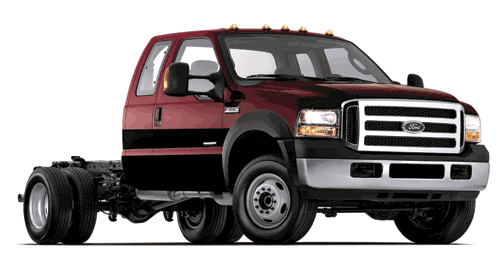
For commercial trucks, use body company truck pools if possible.
Photo: Ford Motor Co.
Is it time to order your new work truck? Concerned about order-to-delivery times? Check out these seven tips:
The end user should plan at least 90 days in advance of when a vehicle is needed. Some advanced planning by the end user will save hundreds and maybe thousands of dollars in acquisition costs by not having to buy a vehicle out of stock instead of using a factory order.
Have the dealer or fleet management company check the manufacturer's downtime at the plant. This can be invisible to the end user, but can add weeks to the total delivery time.
Before ordering a specific model, have the dealer or fleet management company double-check with the manufacturer to see if any options or standard components are on hold or in short supply. This can hold up an order for weeks or months.
For commercial trucks, use body company truck pools if possible. The fact that the truck is sitting on the ground and in stock at the body company can save eight to 12 weeks alone on total delivery time.
Use the vehicle manufacturer's vehicle pools if possible. One of the best-kept secrets is that both Ford and GM have pool vehicle access for select cars.
Make sure the dealer or fleet management company sends a purchase order immediately to the body company for any upfit that will be installed on a factory-ordered vehicle. They should tell the body company the approximate delivery date so that the body company can get the equipment ordered before the truck arrives. This alone will save many weeks or months.
Whenever possible, have truck equipment installed by a truck body company close to the delivering dealer. Though factory ship-thru systems are extremely convenient, placing a truck back into shipping traffic can add a week or two to the shipping time, especially for medium-duty units. In this way a truck can be upfit after it arrives at the end destination and doesn't need to be re-shipped. This works best with smaller orders of one to 10 units.
Glossary of Ordering and Shipping Terms
Bailment pool: A "pool" or inventory of already-built vehicles on consignment at body companies, awaiting sale and upfit by dealers or leasing companies.
Body company: A fabricator that manufactures and installs special equipment for vehicles. Also the location where a vehicle is shipped to be upfit with equipment not installed at the factory.
Completed vehicle: A fully manufactured truck, including the chassis, body and usable cargo area.
Factory order: A new vehicle order placed directly with the manufacturer by the dealer or leasing company to meet the user's exact specifications.
Incomplete vehicle: Vehicle chassis that is completed by adding specialized equipment.
Lead time: The anticipated length of time between an order's placement and delivery.
Ship Thru: The process of shipping a vehicle from the manufacturer to a body company for equipment installation. The completed vehicle is returned to the manufacturer and then sent to the delivering dealer.
Ship To: The vehicle is shipped from the manufacturer to a body company. The completed vehicle is then transported directly to the delivering dealer or customer location.
Upfitting: The addition of equipment on a vehicle not installed by the manufacturer.
Originally posted on Work Truck Online
More Operations

Small Fleet Lessons That Can Make a Big Difference | Business Fleet Brief
From used-vehicle costs and lost keys to safety tech and replacement planning, this Business Fleet Brief breaks down practical lessons that can make a big difference for small fleets.
Read More →
Automotive Fleet Opens 2026 Personal Use Survey for Commercial Fleet Managers
Less than two weeks left! Commercial and corporate fleet managers are invited to share how their organizations handle company vehicle personal-use policies, charges, and driver eligibility.
Read More →
You Do Not Have to Be a Big Business to Build the Next Generation
Small businesses may not have the biggest budgets or the biggest fleets, but they do have something powerful. They are close to the communities they serve, and that makes them uniquely equipped to help shape the next generation of automotive and fleet talent.
Read More →
How Small Fleets Can Stop Losing Time to Lost Keys
Lost keys can mean delayed jobs, idle vehicles and unexpected replacement costs. See how small fleets are using digital key management to keep vehicles moving and improve accountability.
Read More →
How to Build Custom Fleet Tools With AI and Vibe Coding [Webinar]
A new Automotive Fleet webinar explores how fleet managers are using AI and vibe coding to automate routine work and create simple operational tools without traditional programming skills.
Read More →
You May Be a Fleet Manager (Even If No One Told You)
Managing vehicles may not be your full-time job, but the costs, risks, and responsibilities are still very real. Business Fleet In Motion is here to help small and growing businesses make smarter fleet decisions without needing a full fleet department.
Read More →
Fleet Management Without a Fleet Department?
No fleet department? The work still has to get done. Learn how to prioritize your most critical vehicles, catch problems before they become downtime, and build a simple routine that keeps your small fleet moving.
Read More →
Why the IRS Raised Its Mileage Rate in the Middle of 2026
Fuel-price volatility drove the rare increase to 76 cents per mile, the fifth midyear adjustment since 2000.
Read More →
What Fleet Legends Wish Every Small Fleet Manager Knew
Twelve fleet leaders share the lessons they learned the hard way on leadership, communication, relationships, and building a stronger fleet.
Read More →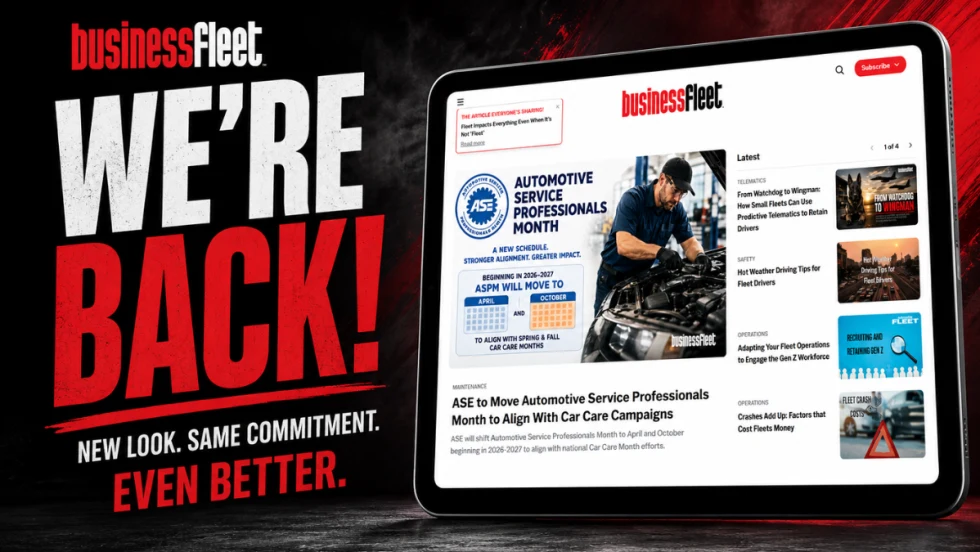
We're Back! Business Fleet Returns With a Fresh New Look
Check out our redesigned website with a faster experience and a renewed commitment to serving small fleet professionals.
Read More →