


Is Diesel Still a Good Deal?
Skyrocketing fuel prices prompted us to take a new look at diesel-powered pickups. We collected diesel wisdom from the experts and turned it into hard numbers, then combined them with current fuel prices and fixed and variable costs to answer our question.

The Duramax 6600 Turbo-Diesel offers 310 HP and 605 lb.-foot of torque starting at 1,600 RPMs
Photo: General Motors
What’s all the fuss with diesel these days? With gas prices lingering in the stratosphere, the public is perking up to the potential of 20 to 40 percent better fuel economy with diesel over gas. With a host of new car models offering cleaner burning diesel engines, manufacturers are successfully steering public perception away from the exhaust-belching image of diesel’s past. We thought it would be time to take another look at diesel engines in work trucks.
We turned traditionally anecdotal evidence (namely, diesel engine’s longer life) into hard numbers. We then combined those numbers with fixed and variable costs to come up with a projection of yearly costs between two diesel and gas pickup models. We had to factor in a recent turn of events as well. Diesel prices, traditionally lower than gasoline, have jumped 58.8 cents a gallon from last year compared to 43.5 percent for gas. As of December 2004 diesel prices at the pump were about 15 cents more than gas.
Is diesel still the right choice?
Loud and Dirty? Diesel Has Cleaned Up Its Act
Remember that familiar diesel engine rattle? New diesel engines have advanced fuel injection control systems to provide smoother combustion and hence less rattle. Complex vibration and noise-deadening systems further decrease the familiar sounds associated with earlier diesels. Today’s trucks and buses are eight times cleaner than those built just a dozen years ago.
Of the five major emissions from internal combustion engines—carbon monoxide, hydrocarbons, carbon dioxide, particulate matter and nitrogen oxides—diesel emits only small amounts of the first three.
Decreasing the amount of particulate matter and nitrogen oxides in diesel emissions is still a major concern.
The Cold Start Problem
Diesel engines used to have problems starting in cold weather. These problems arose from the crystallization of wax (all diesel fuel contains wax) at low temperatures that blocked fuel filters and lines.
"Technology has minimized cold-start problems," says Colin McBean, truck communications manager for Chrysler.
Products such as block warmers, grid heaters and glow plugs help to curb diesel engine’s cold-start issues. Leo Klein, owner of Pioneer Construction in Mandan, N.D. has been a diesel owner since the 1970s. Klein says diesel’s reputation for hard starting in cold weather is a thing of the past.
“I’ve got a Dodge pickup that I’ve been running all winter on Number 2 diesel with no additives, and it gets about 19 miles a gallon,” he says.
Pulling Power Plus Fuel Economy
Diesels aren’t known for rapid acceleration. The heavier crankshaft, pistons and connecting rods in a diesel engine prevent it from spinning as fast as a gas engine, explains Cliff Wheeler, design system engineer at General Motors who works with the company’s diesel program. GM’s Duramax diesel is rated at 3000 RPM compared to 5000 RPM for a gas engine.
Yet the diesel engine’s torque output makes it ideal for towing and hauling. The improved fuel economy is a bonus on top.
“One customer bought a crew cab diesel truck. He hauls horse trailers to Indiana every other week,” says Rich Savilla, fleet sales manager for Bert Wolfe Ford in Charleston, W.V. “He told me he gets 19 miles per gallon with a loaded horse trailer.”
Bill Muller, fleet manager for John Elway Dodge in Englewood, Colo., advises customers who need a truly heavy-duty vehicle to purchase the Cummins engine offered in the Dodge Ram series.
“Depending on the weight you’re pulling, a diesel will get 14 to 16 miles per gallon while towing,” Muller estimates. “A gas truck would get 10 miles per gallon.”
That Cummins engine has been redeveloped for 2005 trucks. McBean says Chrysler’s new Cummins 610 Turbo Diesel performs very well when hauling a load, offering noticeable power (325 hp) with a small displacement. That engine gives 610 lb foot of torque starting at only 1600 RPM, he says.
Muller sold a diesel to a tile layer.
“He says that carrying two heavy pallets of tiles in the diesel is like a little country drive,” Muller says. “Since he couldn’t move the weight as fast in his old gas-powered truck, he says that the diesel saves him about one or two days a month. He’s making more money with that truck.”
Diesel Engine Durability
“I’ve had diesel pickups almost since Chevy came out with them in 1978,” says Klein, owner of Pioneer Construction. “Half of our pickups are diesels.” Even though some of the early diesels had reliability issues, Klein says his experiences have been relatively trouble-free.
“I’ve put 75,000 to 85,000 miles a year on some diesels and we’ve never had a major repair,” he says. “We’ve got one old diesel with 300,000 miles on it.”
Muller expects a gas-engine truck to last around 200,000 miles, while a Cummins diesel will last 300,000 to 400,000 miles with proper care. McBean from Chrysler concurs. He says a gas engine will achieve 125,000 miles on average before an overhaul is needed, while a diesel engine will go three times that. He says with proper maintenance the Cummins 610 can achieve approximately 350,000 miles before an overhaul. Fleet sales manager Savilla says price is less of an issue for business buyers. “Individuals may complain about the price of a diesel, but companies never do,” he says. “They know what they’re getting—reliability, better gas mileage and longer life. You can’t beat the diesels for durability.”
Diesel Versatility
Versatility is another area where the diesel engine shines, says Ken Forbes, a brand manager for trucks at Ford. “Diesels are frequently selected when a company uses power take off (PTO) or auxiliary equipment,” Forbes says. Diesels work well with the long idling times of some equipment powered by the truck’s PTO, or when truck is used in a demanding environment.
Be Diligent on Maintenance
Although diesels enjoy a well-deserved reputation for toughness and long life, they cannot be maintained just like a gas-powered car or truck. Roger Podoll, owner of Roger’s Repairs in Wautoma, Wis., has more than 20 years of experience with diesel engines, and he advises businesses to be diligent in performing scheduled maintenance.
“It’s better to do maintenance a little sooner than expected,” Podoll says. “It’s extremely important to service transmissions. A new Ford transmission will cost $2,000. It’s all electronic.”
Choosing the right motor oil is especially important. “Oil gets dirty in diesels sooner,” Podoll says. “You can’t get away with delaying your oil changes like you can in a gas-powered engine.”
Coolants are another area where it doesn’t pay to skimp. “If you don’t change your antifreeze, it starts pinging microscopic holes through the cylinder walls, which will go into the engine,” Podoll warned.
Doing the Math
We’ve put together a couple of our world-renowned data charts to illustrate the possible total average annual costs of a diesel and a gas engine.
Chart 1 compares the average annual cost of a gas- and diesel-powered 2004 3/4-ton Dodge Ram 2500 ST (regular cab) averaging 25,000 miles a year. We ran the gas-powered truck to 100,000 miles and retired it at four years (left column). In the right column we have the same truck equipped with a diesel engine, also averaging 25,000 miles a year. We ran this diesel until 150,000 miles and six years before selling it. We’re going conservative here—remember these engines can go well beyond 300,000 miles.
We have pegged the cost of gasoline at $1.96 a gallon and diesel fuel at $2.16 a gallon, the current national average prices as of December 3, 2004. We estimated the fuel economy of the diesel to be 14 miles per gallon compared to 10 mpg for the gas engine. The increased fuel mileage of diesel equates to a little over $1,043 a year in fuel savings.
Because the diesel engine requires more frequent maintenance than a gas engine, we have doubled the oil and lube costs of the diesel. We’ve also estimated the mechanical repair cost to be greater on the diesel due to the increased mileage by retirement. We’ve added tire expense for the same reason.
On the fixed cost side, by retaining the diesel for 72 months versus the gas-powered pickup for 48 months, we save a little over $525 a year in depreciation.
The lease/finance rate is the same on both vehicles. While the total cost is higher on the diesel due to the additional acquisition cost for the diesel engine, we can spread the lease/finance expense over 72 months on the diesel versus 48 months on the gas-powered unit. This equates to a $100 savings a year for the diesel.
The bottom-line total average annual cost for the diesel is $10,570 compared to $11,598 for the same gas-powered model—a difference of $1,030.
In Chart 2 we analyze a Chevy Silverado 2500. This time we extend the life of the diesel Silverado to 175,000 miles and seven years—still a conservative estimate of engine life. Taking the diesel out to 84 months produces an even greater annual depreciation expense savings—nearly $875 a year compared to the $525 in Chart 1. That same 84-month timeframe also produces an annual lease/finance savings on the diesel of a little over $200 annually.
The life of the diesel-powered pickup at 175,000 miles and 84 months equates to an average annual savings of about $1,460 a year on the diesel. Diesel trucks (and cars) cost more than gas-powered trucks. Yet they hold their value better too, according to Automotive Lease Guide. Both diesel models in our examples are worth about $4,000 more after a year than their gas-powered siblings.
The Final Deal with Diesel
For the company that needs heavy-duty performance—and plans to hang on to a vehicle for the long term, light-duty diesel trucks are still an operational and financially intelligent decision.
Originally posted on Work Truck Online
More Operations

Small Fleet Decisions, Big Business Impact | Business Fleet Brief
Are your vehicles helping or hurting your bottom line? This month's Business Fleet Brief covers fleet costs, insurance, a mobile business, winter safety, and more.
Read More →
5 Signs Your Small Fleet Has Outgrown the Way You Manage It
More vehicles, same old process? Learn five signs your fleet management needs an update and practical ways to keep up as your business grows.
Read More →
Is Your Fleet Making Your Business Money or Quietly Costing It?
Your vehicles keep your business moving, but are they helping your bottom line? From underused vehicles and unexpected downtime to the real cost of completing a job, here's how to find out whether your fleet is working as hard as your business needs it to.
Read More →
Les Schwab Tires Launches Foundation With $100,000 for Community Recovery
Les Schwab Tires launches a foundation with $100,000 to support recovery for Silver Rail Elementary and the Bend community following a school shooting.
Read More →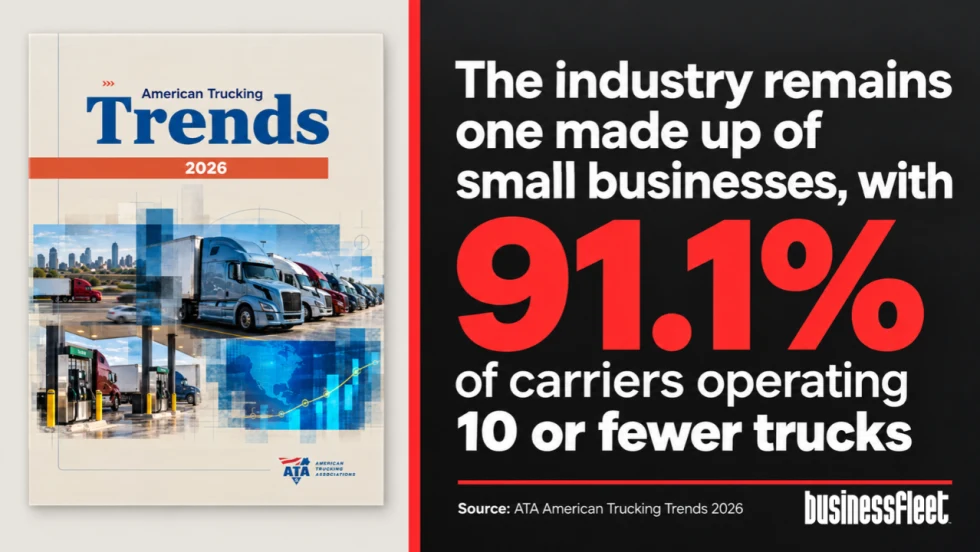
Small Carriers Make Up 91% of Trucking Industry as Freight Revenue Rises
The latest American Trucking Associations report shows modest gains in freight tonnage and revenue, with businesses operating 10 or fewer trucks accounting for most carriers.
Read More →
Small Business Vehicle Purchases Slip as Owners Pull Back on Expansion
New NFIB survey data shows fewer small businesses purchasing or leasing vehicles as inflation, hiring challenges, and borrowing costs weigh on expansion plans.
Read More →
Growing Fleets, Bigger Challenges | Business Fleet Brief
From growing pains and weather risks to workers' comp, new vehicles, and telematics gaps, this month's Business Fleet Brief covers what small fleets need to know.
Read More →
Your Business Grew, Did Your Fleet Management Program Grow With It?
Small fleets often grow faster than the processes supporting them. Here’s how to recognize when informal fleet management has stopped working and what to formalize first.
Read More →
Small Fleet Lessons That Can Make a Big Difference | Business Fleet Brief
From used-vehicle costs and lost keys to safety tech and replacement planning, this Business Fleet Brief breaks down practical lessons that can make a big difference for small fleets.
Read More →
Automotive Fleet Opens 2026 Personal Use Survey for Commercial Fleet Managers
Less than two weeks left! Commercial and corporate fleet managers are invited to share how their organizations handle company vehicle personal-use policies, charges, and driver eligibility.
Read More →