



Learn More: What Fleet Legends Wish Every Small Fleet Knew

Small businesses may not have the biggest budgets or the biggest fleets, but they do have something powerful. They are close to the communities they serve, and that makes them uniquely equipped to help shape the next generation of automotive and fleet talent.
Small businesses may not have national workforce budgets, but their support can still create the hands-on experiences that introduce young people to vehicles, problem-solving, and future automotive careers.
Business Fleet
*Summarized by AI
A kid does not know your employee count. They do not know whether your fleet has six vehicles or 600. They do not know your annual revenue, your recruiting budget, or whether your company has a formal workforce-development strategy. They know you were there.
That thought followed me around Derby Downs during the Corporate Soap Box Derby Challenge, somewhere between racing Team Fletcher down a 996-foot hill and watching the families, volunteers, local businesses, and kids who make the Derby feel like much more than a race.
And it made me wonder whether we have been thinking about the small-business role in building our future workforce all wrong. I came home from Akron thinking about soap box racing, sure, but also thinking about small businesses in a way I had not expected.
Yes, Team Fletcher raced in the Corporate Soap Box Derby Challenge. Yes, I absolutely enjoyed making it all the way to the final race. And yes, I am still just a little bit delighted that our rookie team managed to do that. But what stayed with me wasn't really the race itself. It was the feeling of being at Derby Downs and seeing what happens when a community decides that giving kids a place to build, compete, learn, and belong is worth its time.
That is what kept rattling around in my head on the flight home.
In Work Truck recently, I wrote about how our workforce problem starts earlier than we tend to admit. We spend a lot of time talking about recruiting people into automotive careers, but not always enough time talking about how young people get interested in automotive in the first place. That is still true. But for Business Fleet, I think there is another layer to it, and honestly, it may be one of the most hopeful parts of this conversation.
Small businesses may be better positioned than anybody to do something about it.
That may sound backward at first.
When we talk about workforce development, we usually picture the big moves. Big grants. Big scholarship funds. Big training programs. Big national campaigns. All of that matters. We need every bit of it.
But if the question is not just how to hire people, but how to help them care in the first place, then being small may actually be a strength.
Large companies can do impressive things. They can launch national initiatives, create polished campaigns, build formal pipelines, and put real money behind workforce programs.
Small businesses have something different, and in some ways, more personal. They are already in the neighborhood.
Their vehicles are parked at the baseball field. Their owner sponsors the school fundraiser. Their technician goes to church with your neighbor. Their office manager knows half the town. Their trucks drive the same streets kids grow up on. Their name is not just a logo on a website. It is something familiar.
That matters more than we sometimes give it credit for. Think abut it: A kid may not remember a corporate workforce messagebut they will absolutely remember the local company that helped make something possible.
That is one of the things the Soap Box Derby brings into focus. For a lot of adults, it is easy to look at it and see a race. For a kid, though, or really for anyone who has ever felt that little jolt of curiosity when something moves, and you want to know why, it is much more than that. It is a hands-on invitation into problem-solving, experimentation, and the kind of mechanical curiosity our industry keeps saying it needs more of.
And the businesses that show up around that experience are not background noise. They become part of the memory.
I think we talk too often about sponsorship in the language of exposure. How many impressions? How many eyes? Where does the logo go? And whether the return pencils out. Again, those are fair questions. Businesses have to make smart decisions. I am not suggesting otherwise.
But there is another kind of value here that does not fit so neatly into a spreadsheet… Imagine being a kid whose Soap Box Derby season was supported by the local business down the road.
It could be a contractor, a service company, a dealership, a delivery operation, a small repair shop, or a regional fleet. Maybe one of the employees helps with the car. Perhaps the company lets the team use space to work on it or a technician explains why a wheel alignment adjustment matters. Or, maybe someone from the company is standing at the finish line on race day cheering like crazy.
That kid grows up seeing that company and its employees around town, and that logo means something more now; not in a branding-strategy way. In a real-life way.
Years later, when that kid is old enough to start thinking about jobs, careers, or what kind of work feels interesting, that business is no longer just some name on the side of a truck. It is already connected to a good memory, a first experience, a moment of being encouraged, or a time when an adult showed them something cool and made them feel included.
That is not a small thing. In fact, if we are being honest, that may be one of the most powerful kinds of workforce development there is.
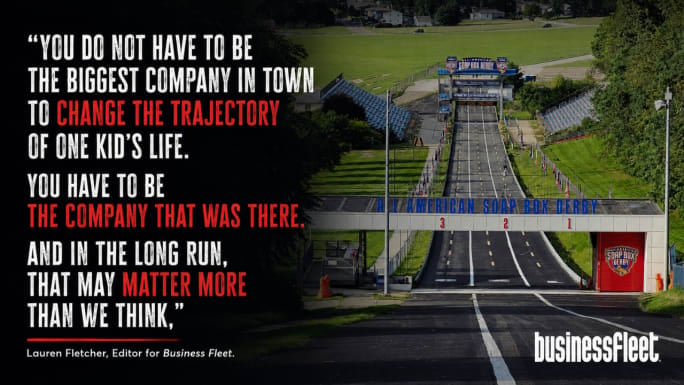
Small businesses do not need massive budgets or formal workforce programs to make a lasting impact. Showing up for local programs, sharing expertise, and creating hands-on opportunities can help young people see a future they may never have considered otherwise.
Business Fleet
This is the part I keep coming back to: The workforce pipeline does not begin when somebody fills out an application. It begins much earlier, when a kid first decides something is interesting enough to imagine themselves doing one day. That was really the heart of my earlier Derby piece, and it still feels right to me. Exposure comes first. Curiosity comes first. The spark comes first.
And small businesses are in a really good position to create that spark because they are close enough to make the industry feel real.
That is important in fleet, even more than in some other sectors, because fleet careers are still strangely invisible to a lot of people. Kids see the vehicles. They see the vans, pickups, service bodies, work trucks, delivery fleets, and contractor vehicles rolling through town every day. But they do not necessarily know what sits behind them.
They do not see the decisions about spec'ing vehicles. They do not see maintenance schedules, uptime planning, fuel decisions, safety programs, route planning, procurement, cost control, upfitting, diagnostics, or the thousand daily details that keep a business moving.
They definitely do not grow up saying, "I want to be a fleet manager someday." (I say that with love, as someone who would be thrilled if more people did.) But that invisibility is exactly why local businesses matter here. They can pull the curtain back in a way that feels immediate and tangible. They can let young people see the work, ask questions, and connect dots they may not have even known existed.
I also think small businesses sometimes underestimate what they have to offer. Not every company can cut a major sponsorship check, build a formal internship program, or have extra time falling from the sky. But the bar to making an impact may be lower than we think:
That isn't nothing, it's actually a lot.
One thing I like about the Soap Box Derby model is that it reminds us community support can take different forms. The organization provides resources for local programs, racers, volunteers, and sponsorship support, and even has a process for communities interested in starting a soapboxderby.org. In other words, this is not only for giant organizations with giant budgets.
And even if Soap Box Derby is not the exact fit in your market, the broader point still holds. Local STEM programs, school career days, youth organizations, shop classes, skills competitions, tech programs, and community events need engaged businesses more than they need a perfect strategic plan.
Sometimes support looks like money. But more often than not, it looks like time, access, and being the company that says yes.
Another reason I think small and mid-size businesses may have a real edge here is that they do not feel as distant. A big national company can absolutely inspire people, but a small business can feel reachable. A kid can imagine working there because the business feels like part of the world they already know.
They may know the owner, or at least know someone who knows the owner. They may have seen the same vehicles for years. They may have parents who have used the company, neighbors who work there, or teachers who mention it. If they meet someone from that business at a local event and hear what they do, it does not feel like some abstract corporate career path. It feels possible.
That word matters. Many workforce development conversations focus on awareness, and awareness is important. But what people really need is a way to picture themselves in the story. That is harder to do when the industry feels distant, but much easier when a local business makes it feel familiar.
And I do not just mean technicians here. This is bigger than one role. Business fleets need people across operations, service, sales, maintenance, logistics, administration, management, and leadership. They need people who understand vehicles, yes, but also people who understand business, people, technology, and process. Some kids will be drawn to the hands-on mechanical side. Some will be drawn to the organizational side. Some will love the vehicles. Some will love the problem-solving.
The point is not that every kid who touches a soap box car becomes an automotive professional. It’s that early experiences help people see possibilities they might not have otherwise seen.
There is something else I think is worth saying plainly. Small businesses do not always have to wade through layers of approval to do a good thing. They can move faster. They can be more personal. They can make decisions based on what their community actually needs rather than what fits a national template.
That flexibility matters. If a local school needs a vehicle for a demo day, a small company may be able to say yes by Friday. If a community program needs a sponsor for one kid, a small business may be able to do that quietly and without fanfare. If a local race needs volunteers, a small team may be able to bring people who really want to be there, not because it is on a corporate volunteer calendar, but because they genuinely care.
That kind of involvement feels different because it is different. It is not less meaningful because it is smaller. In many cases, it is more meaningful because it is closer. And I think that closeness is exactly what our industry needs more of right now.
The automotive and fleet worlds love a big solution. We like programs, systems, frameworks, strategies, and all the rest. I do too. There is a place for all of it. But sometimes I think we talk like there is going to be one answer to the workforce problem, and there probably is not. It is going to take a lot of answers.
It is going to take schools, employers, trade programs, scholarships, mentorship, community organizations, technical education, and media that does a better job telling the story of why these careers are interesting in the first place. That was a huge part of my original argument, and I still believe it. We are not going to solve this by only talking about shortages. "Please consider this career because we are desperate" is not exactly inspiring.
But I also think it will take something less formal and even more powerful. It is going to take thousands of small moments in local communities:
That is how industries become real to people. And that is how a future workforce starts to take shape before anyone realizes it.
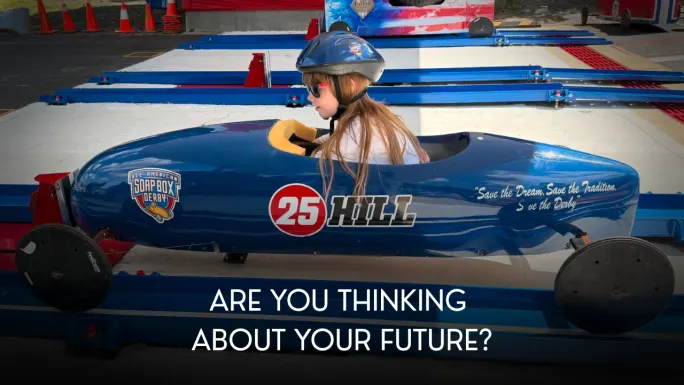
The workforce pipeline starts long before a job application. Programs like the Soap Box Derby give kids a chance to build, experiment, compete, and discover interests that could eventually lead them into automotive, fleet, or skilled-trades careers.
Business Fleet
The biggest thing I took from Akron, beyond the fact that gravity is both thrilling and mildly offensive when it is working against you, is that impact does not have to come from size. Sometimes we assume the companies best equipped to shape the future are the ones with the most money, the most employees, or the biggest footprint.
But if the goal is to help a young person feel seen, curious, encouraged, or excited enough to imagine themselves in this world one day, then small businesses may be among the best tools this industry has because they are there.
They are part of the local fabric. They can show up, not as a giant institution, but as a familiar presence that says, "Come take a look. This is what we do. You might like this too."
That is not flashy or easy to measure. It probably does not fit neatly into a quarterly report. But, it is exactly what people remember. And that is exactly the point.
I don't think the next generation of automotive and fleet talent will come only from the biggest national efforts. It's going to come from the small business that helped sponsor a race car, brought a truck to an event, opened its shop doors, answered a kid's questions, or kept showing up long enough to make a real impression.
You do not have to be the biggest company in town to change the trajectory of one kid's life. You have to be the company that was there. And in the long run, that may matter more than we think.
Small businesses can leverage their close ties to local communities to create apprenticeship programs, offer internships, and provide mentorship opportunities that nurture and develop the skills of young talent.
*Summarized by AI
Loading data...

Operations
Small fleets often grow faster than the processes supporting them. Here’s how to recognize when informal fleet management has stopped working and what to formalize first.
Operations
Small businesses may not have the biggest budgets or the biggest fleets, but they do have something powerful. They are close to the communities they serve, and that makes them uniquely equipped to help shape the next generation of automotive and fleet talent.

Operations
No fleet department? The work still has to get done. Learn how to prioritize your most critical vehicles, catch problems before they become downtime, and build a simple routine that keeps your small fleet moving.
Operations
Twelve fleet leaders share the lessons they learned the hard way on leadership, communication, relationships, and building a stronger fleet.
Operations
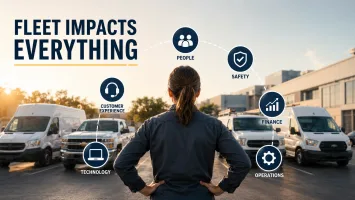
Small fleet managers do far more than manage vehicles. From operations to safety and retention, fleet impacts nearly every part of the business.
Fleet may be one responsibility, but it impacts everything. Here’s how small fleet leaders manage pressure and create control where it matters most.

Safety
Small fleets can improve safety without big budgets by building simple routines, spotting blind spots early, and creating habits that stick.

Operations
Here’s a more realistic playbook for small fleet leaders who want to stay effective without burning out.
Operations
Small fleet managers: boost efficiency, reduce downtime, improve maintenance, and run a smarter fleet with these 15 quick, practical time-saving tips.
Operations
Learn the six rules to boost safety, lower operating costs, improve uptime, and streamline daily operations for small fleet operations.