



Keep Learning: The Small Fleet Leader’s Guide to Reducing Stress Today

Twelve fleet leaders share the lessons they learned the hard way on leadership, communication, relationships, and building a stronger fleet.

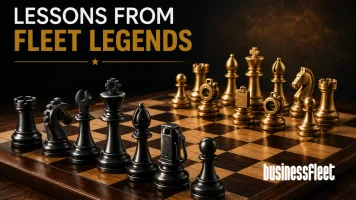
Leadership requires thinking several moves ahead. A chessboard of fleet-inspired pieces illustrates the strategic decision-making, long-term planning, and people-focused leadership lessons shared by industry veterans in Lessons From Fleet Legends.
This image was generated by OpenAI. Please refer to our terms of use.
*Summarized by AI
It's easy to assume the biggest fleet challenges belong to the biggest fleets. After all, managing thousands of vehicles across multiple locations sounds complicated. But spend a little time talking to fleet managers who oversee 50, 100, or even a few hundred vehicles, and a different picture starts to emerge. Many smaller fleet operators are juggling the same responsibilities as their counterparts at much larger organizations, but with fewer resources, smaller teams, and much less margin for error.
They may be handling acquisition planning in the morning, responding to driver questions before lunch, reviewing accident claims in the afternoon, and trying to make sense of the latest technology trend before heading home. In many cases, they're not just leading the fleet operation. They are the fleet operation.
That's why I found myself thinking about small fleets while interviewing some of the industry's most respected leaders for the Legends of Fleet series.
Over the past year, I sat down with leaders whose careers spanned public and private fleets, utilities, manufacturing, consulting, technology, and transportation. Some managed thousands of assets. Others spent years working in lean operations where resources were limited, and expectations were high. Some started as technicians. Others found their way into fleet through operations, finance, sales, or a series of opportunities they never expected.
What surprised me wasn't how different their careers were. It was how often they arrived at the same conclusions.
Again and again, these leaders came back to the same themes:
The lessons they shared weren't really about fleet size; they were about leadership. And for small fleet managers, that may be the most encouraging takeaway of all.
One of the biggest misconceptions about leadership is that leaders are supposed to have all the answers.
That's especially true in fleet. Whether you're managing 50 vehicles or 5,000, people expect you to know the right replacement cycle, maintenance strategy, vendor, policy, and have an answer when something unexpected happens. It's a lot of pressure, especially when you're working in a small operation where there isn't always another fleet professional down the hall to bounce ideas off of.
The fleet legends I spoke with would tell you that's a dangerous mindset. Rick Longobart learned that lesson through experience. Early in his career, he admits he often approached challenges with what he described as a "my way or the highway" mentality. Like many leaders, he believed confidence meant having the answer and sticking to it.
Over time, he learned something different.
As Longobart told me, "The biggest challenge I've faced is learning to admit when I'm wrong."
That realization changed the way he approached leadership. Instead of focusing on being right, he focused on listening, understanding different perspectives, and finding better outcomes. It wasn't always easy, but it made him a better leader and helped him build stronger relationships with the people around him.
John Dmochowsky arrived at a similar conclusion from a very different path. Before leading global fleet operations, he spent years in sales and business operations where success often felt immediate and measurable. Fleet taught him patience and perspective.
As Dmochowsky explained, "Fleet success isn't about perfection. It's about progress."
That idea surfaced repeatedly throughout these conversations. None of these leaders claimed to have all the answers. In fact, many openly talked about mistakes, lessons learned the hard way, and moments when they had to rethink their approach.
For small fleet managers, that's an important reminder.
You're not going to have every answer. You won't always have the budget, staff, or tools you'd like. There will be days when you're making the best decision you can with the information available, and that's okay.
The goal isn't perfection, it's progress.
If there was one topic that came up in nearly every conversation, it was relationships.
Not networking in the transactional sense. Not collecting business cards at conferences or adding names on LinkedIn because someone told you it was important. The fleet legends talked about relationships as a professional survival skill.
They talked about the people you call when you're facing a challenge you've never seen before. The people who can help you avoid a costly mistake. The people who understand exactly what you're dealing with because they've already lived through it themselves.
Mark Petersen was perhaps the most direct about it. During more than four decades in fleet, he told me not a single professional opportunity came from a blind application. Each one came through relationships.
As Petersen said, "If someone wanted a few minutes of my time, I gave it to them. You're missing a huge resource if you don't."
That's a powerful lesson for small-fleet managers, as many don't have access to large internal support teams. When you're the fleet manager, analyst, procurement coordinator, and problem solver all rolled into one, your professional network often becomes an extension of your department.
Theresa Belding learned that lesson early in her career. Many of the answers she needed weren't sitting inside her own organization. They were waiting in industry associations, peer groups, conferences, and conversations with people who had already solved similar problems.
As Belding advised, "AFLA, NAFA, your fleet management company forums, just get out there and meet your peers."
Looking back, it's hard to ignore how often relationships showed up in these leaders' stories. New jobs came from relationships. New ideas came from relationships. Solutions to difficult problems came from relationships. Mentors opened doors. Colleagues shared lessons. Peers provided perspective.
Sometimes, the answer you're looking for isn't a new software platform or a consultant. Sometimes, it's another fleet manager picking up the phone.
Fleet managers spend a surprising amount of time in the middle, balancing competing priorities from every direction. Drivers want one thing, leadership wants another, budgets impose limitations, policies set boundaries, and departments across the organization each have their own concerns and expectations. It's a position that can make fleet feel like the department that's constantly delivering bad news.
The leaders I interviewed suggested a different approach. Lisa Kneggs learned early on that simply denying a request rarely solves the underlying issue. More often, it creates frustration and misunderstanding. As Kneggs explained, "Just saying no doesn't help. You have to explain the why."
That lesson surfaced again and again throughout the Legends series. The most effective fleet leaders weren't necessarily the ones with the most authority. They were the ones who could help people understand the reasoning behind a decision, the risks being managed, and the bigger picture driving the outcome.
Scott Rood discovered that people are far more likely to support a decision when they understand the reasoning behind it. As Rood told me, "If they understand why we're doing something, they're more likely to get on board."
Amy McAdams built much of her leadership approach around that same principle. Whether she was implementing a new process, reviewing sensitive camera footage, or asking someone to take on a difficult task, she found that people performed better when they understood the purpose, the context, and how their work connected to the bigger picture.
That's a lesson that extends far beyond fleet.
Most people don't resist change because they enjoy being difficult. More often, they resist because they don't understand it. They don't see the business reason. They don't understand the risk. They don't know how the decision affects the larger organization.
The best fleet managers recognize that communication isn't simply delivering information. It's creating understanding, and that's a skill no software platform will ever replace.
It's impossible to talk about fleet today without talking about technology. Telematics systems generate more data than ever. Dash cameras provide visibility that would have seemed impossible a decade ago. Artificial intelligence is beginning to influence everything from maintenance planning to data analysis. Connected vehicles continue to create new opportunities and new questions.
But several fleet legends offered the same warning: Don't confuse information with insight.
Oleg Cytowicz has watched the industry evolve from paper records and manual calculations to sophisticated systems capable of producing enormous amounts of information.
As Cytowicz told me, "The amount of information we get now is mind-blowing. But it's easy to drown in it." His advice was straightforward, adding: "If you're handed a report or a recommendation, ask how they got to that conclusion."
Matthew Betz expressed a similar concern. He believes fleet leaders must become even more disciplined about determining which information matters and which information is simply noise.
As Betz pointed out, "The amount of data is only going to increase."
Kneggs sees the same challenge from a practical perspective. While she recognizes the value of telematics, she also understands the reality most fleet managers face.
As Kneggs noted, "There is so much data in the telematics world that you don't have time to look at everything."
That's particularly true for small fleets. Technology can help you work smarter. It can improve visibility. It can identify opportunities and risks. It can help you make better decisions. But it can't make those decisions for you. The legends repeatedly returned to the same idea: understand the problem first. Then decide whether technology is the answer.
Small fleet managers spend much of their time solving the problem directly in front of them, and for good reason. Vehicles break, budgets shift, drivers need support, leadership wants answers, and the day rarely waits politely for a long-term strategy session to appear on the calendar. The work feels urgent because, most of the time, it is.
The best leaders still find ways to look beyond the immediate issue. Larry Campbell built much of his career around that kind of long-term thinking, including a fleet facility project that first appeared on a planning document in 2003 and was not completed until 2023. Many leaders might have abandoned the effort somewhere along the way, but Campbell kept the goal alive for 20 years.
As Campbell advised, "Always think five to 10 years out. You own that decision, so make sure it'll hold up."
That perspective feels particularly relevant in today's fleet environment. Whether you're evaluating vehicle replacement strategies, facility investments, alternative fuels, or emerging technologies, the decisions you make now may affect operations for years to come.
Belding approached long-term thinking from a different angle. After navigating OEM disruptions, allocation challenges, and supply chain issues, she became a strong believer in flexibility.
As Belding said, "Remain open to all your options. Don't close doors. Keep relationships open because you don't know what's going to happen."
Petersen shared a similar philosophy. When his organization mandated a 100% diesel fleet, he questioned the assumption and quietly prepared an alternative plan. When market conditions changed, he already had another path forward.
The lesson wasn't about predicting the future. It was about preparing for multiple versions of it. The best leaders aren't necessarily better at seeing what's coming. They're better at staying ready when it arrives.
What struck me most after interviewing these leaders wasn't how often they talked about vehicles. It was how often the conversation eventually moved beyond them.
Again and again, discussions that started with fleet operations, maintenance strategies, budgets, or technology found their way back to people. There was the technician who needed encouragement, the employee who was ready for more responsibility, the mentor who took the time to answer questions early in a career, and the driver who simply wanted someone to explain a decision rather than enforce it.
The details were different. The careers spanned different decades, industries, and types of fleets. Yet the underlying lesson remained remarkably consistent.
Fleet may be built around assets, but leadership is built around people. And while vehicles, technology, and processes will continue to evolve, the ability to build trust, develop others, and create meaningful connections remains at the heart of every successful fleet operation.
Steven Saltzgiver spent more than four decades helping fleets improve performance. Yet when discussing mistakes he sees new managers make, he didn't start with technology, budgets, or maintenance programs.
As Saltzgiver told me, "One mistake I see is fleet managers burying themselves in their office. You need to be out there on the floor, talking to your team and being a resource."
Sam Lamerato built much of his leadership philosophy around the same idea. Birthdays were celebrated. Families were acknowledged. Employees were treated as people first and workers second.
As Lamerato often reminded his teams, "Fleet isn't 'I' or 'they.' It's 'we.'"
Betz emphasized trust throughout our conversation. He believes trust remains one of the most valuable assets a fleet leader can build, as it influences everything from vendor relationships to team performance.
Amy McAdams offered another perspective that stayed with me. Early in her fleet career, someone told her, "No matter where fleet reports on the org chart, you touch every part of the organization."
The longer I sat with that statement, the more powerful it became.
Fleet decisions affect drivers, technicians, operations, safety, finance, HR, leadership, customers, and communities. The vehicles may be the assets we manage, but the work itself is ultimately about people. One thing these leaders have in common is that none of them followed a perfect roadmap.
They didn't step into fleet with decades of experience. They didn't inherit flawless operations. They didn't have access to every answer, every technology, or every resource they wanted. Most of them learned the same way fleet professionals still learn today: by asking questions, making mistakes, building relationships, and figuring things out one challenge at a time.
That's what makes their advice so valuable. It's not theory. It's experience earned over decades. For small fleet managers, that's good news. You don't need a massive budget, a large staff, or the latest technology to become an effective leader.
What you do need is curiosity. A willingness to learn. The humility to listen. And the understanding that the strongest fleet operations are rarely built by one person. They're built through relationships, trust, communication, and a commitment to getting a little better every day.
Looking back across all of these conversations, that's probably the lesson the fleet legends would want future leaders to learn first. The vehicles matter. But it's the people who make the difference.
Fleet leaders emphasize the importance of leading by example and fostering a positive team culture, which can significantly influence fleet performance and morale.
*Summarized by AI
Loading data...

Operations
Small fleets often grow faster than the processes supporting them. Here’s how to recognize when informal fleet management has stopped working and what to formalize first.
Operations
Small businesses may not have the biggest budgets or the biggest fleets, but they do have something powerful. They are close to the communities they serve, and that makes them uniquely equipped to help shape the next generation of automotive and fleet talent.

Operations
No fleet department? The work still has to get done. Learn how to prioritize your most critical vehicles, catch problems before they become downtime, and build a simple routine that keeps your small fleet moving.
Operations
Twelve fleet leaders share the lessons they learned the hard way on leadership, communication, relationships, and building a stronger fleet.

Operations
Small fleet managers do far more than manage vehicles. From operations to safety and retention, fleet impacts nearly every part of the business.

Fleet may be one responsibility, but it impacts everything. Here’s how small fleet leaders manage pressure and create control where it matters most.

Safety
Small fleets can improve safety without big budgets by building simple routines, spotting blind spots early, and creating habits that stick.

Operations
Here’s a more realistic playbook for small fleet leaders who want to stay effective without burning out.
Operations
Small fleet managers: boost efficiency, reduce downtime, improve maintenance, and run a smarter fleet with these 15 quick, practical time-saving tips.
Operations
Learn the six rules to boost safety, lower operating costs, improve uptime, and streamline daily operations for small fleet operations.