


What Wheels Are Actually Doing at 60 MPH | Fleet Vehicle Science Explained
Tire Science for Fleets: Neil deGrasse Tyson breaks down why the tire contact patch hits 0 mph and what that means for traction and wear.

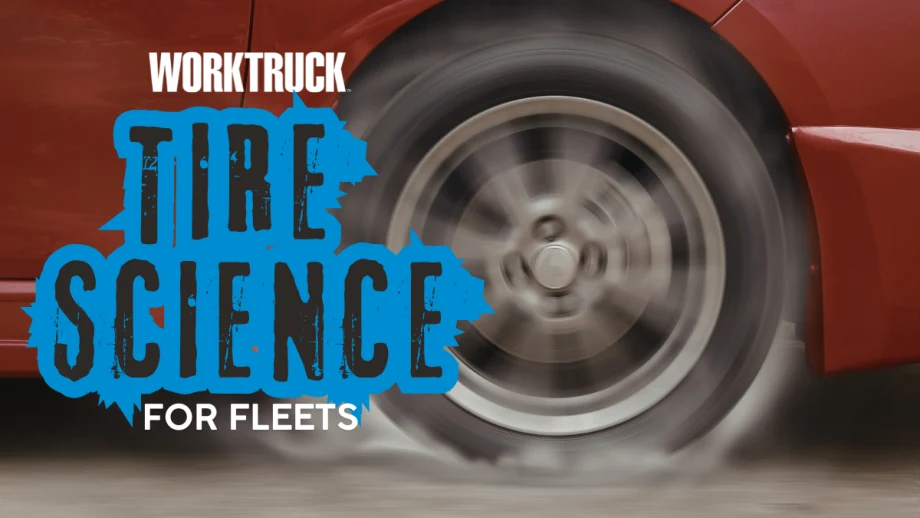
Work Truck’s “Tire Science for Fleets” explores the physics behind tire traction, explaining why the contact patch briefly reaches 0 mph and how that affects safety and wear.
Credit: Work Truck
If you manage a fleet or drive for a living, you already know wheels and tires are where reality lives. You can have the best engine, the cleanest telematics dashboard, and the most carefully spec’ed truck in the yard, but the moment traction gets weird, everything gets real fast.
Stopping distance and handling changes. Tire wear shows up on your budget and your schedule. And the driver feels it immediately. That’s why this explainer grabbed me.
Neil deGrasse Tyson and comedian Chuck Nice take something we all think we understand, “a wheel rolls,” and then flip it into a physics lesson that’s genuinely useful for fleet folks. Not because anyone needs to become an engineer overnight, but because once you see what’s actually happening at the tire and pavement, you start to understand traction, skidding, and tire stress in a totally different way. It makes the invisible stuff visible.
They start with a riddle that sounds like a trick question: What part of a moving vehicle is going backward while the vehicle is going forward?
And before we even get to the backward part, Tyson drops the fact that made me pause: If your driver is cruising at 60 mph, there is a part of that vehicle that is going zero miles per hour.
The Part of Your Truck Going 0 MPH
Here’s how Tyson explained it: “The part of the wheel at any moment in contact with the pavement is not moving at all.”
That little patch of tire touching the road is at 0 mph relative to the pavement.
It sounds insane, but it's legit physics. That momentary zero is exactly why the vehicle moves forward instead of just spinning in place. Tyson puts it simply: “Because part of the wheel is not moving at all… because if it were, you’d be spinning in place.”
If that contact point were sliding, instead of briefly stationary, you’d have a skid, not a clean roll. And for anyone managing drivers, equipment, and risk, the difference between rolling and sliding is everything.
So, every time one of your trucks moves down the road smoothly, it’s because that contact patch hits zero, grips, and rotates through again. Over and over, thousands of times per mile.
Why the Top of the Tire is Moving Twice as Fast
Now here’s where it gets really interesting. Tyson broke down what’s happening across the rest of the wheel: “You get zero at the bottom, the speed of the car in the middle of the wheel, and twice the speed of the car at the top of the wheel,” he explained.
Let’s put numbers on that: If your fleet vehicle is traveling at 60 mph, the bottom of the wheel is at 0 mph. The wheel's center is at 60 mph. The top of the tire is at 120 mph. Every single rotation.
The top of the tire is moving forward at double the vehicle’s speed because it has to rotate down and around to become that stationary contact point.
Tyson summed it up perfectly: “This is the geometry, the math, and the physics of an axled wheel on any moving vehicle.”
And this is where I start thinking about tires differently. Every rotation contains a full range of speeds. Zero. Sixty. One twenty. And everything in between. Multiply that by highway miles, loaded cargo, hot pavement, uneven surfaces, tight turns, and braking cycles, and suddenly, tires feel less like a commodity and more like a physics experiment happening in real time.
They’re absorbing load, managing heat, and maintaining grip, all while parts of them are moving twice as fast as the vehicle itself.
What Part of the Tire is Actually Moving Backward?
Now, back to the original riddle. Once you understand that the bottom of the wheel is at zero, you can follow the logic one step further.
Tyson explained, “Anything lower than the bottom of the wheel is moving backwards. There’s the wheel rolling. The part that’s below the contact point is moving backward… it actually lands in a place behind where it started… that means it moved backwards.”
So even while your fleet vehicle is moving forward, the physics of rotation mean that any part of the wheel assembly that dips below that zero-speed contact point is, at that instant, moving backward relative to the pavement.
So yes, your vehicle is moving forward, but a little slice of the wheel’s rotation is technically happening in reverse relative to the pavement. Which is the kind of sentence that makes you blink, and then go, wait… wow. It feels like a brain teaser, but it’s just rotational geometry doing exactly what it’s designed to do.
And one of the most important lines in the whole conversation is this: “There’s a part of your car that’s going at all speeds from zero up to twice the speed of the car.”
Think about that from a fleet perspective: At any given moment, your wheel includes zero speed at the contact patch, every speed between zero and vehicle speed, the vehicle speed at the center, and every speed up to double that at the top. All happening simultaneously.
That’s not just trivia. It’s a reminder that your tires are doing a lot more work every mile than we give them credit for.
Is a Circle the Only Wheel Shape that Works?
Because Tyson can’t resist going one level deeper, he also pokes at the assumption most of us carry around without thinking about it: a wheel has to be a perfect circle.
He points to the shape used inside a Wankel engine and describes it as “an equilateral triangle, but curve the corners of it and make the sides a little bit convex.”
And then he shares the part that makes your brain do that little buffering wheel of its own. “The distance from the bottom to the top remains the same no matter how it’s oriented.”
So even though it’s not a circle, it can still roll in a way that keeps the “height” consistent. Tyson adds, “You can design a shape where the top is always the same distance from the bottom, even though the center is moving.”
Technically, that means you can create a non-circular shape and still get a steady ride in the right setup. No, we’re not swapping your fleet’s wheels for rounded triangles anytime soon, but I love the bigger point: engineering doesn’t just accept what feels obvious. It tests it.
Where Safety and Tire Costs Actually Start
If you take nothing else from Tyson and Nice’s wheel rabbit hole, take this: your tires only “work” when that contact patch can grab the road instead of sliding across it.
And honestly, it's in fleet where that mindset matters. We live at the intersection of physics and practicality every day, whether we call it that or not.
Because every mile your fleet runs depends on that tiny patch of rubber hitting zero miles per hour at exactly the right moment. Every safe stop depends on traction. Every avoided skid depends on that contact point doing its job.
So, for a fleet manager with zero physics background, here’s why this matters in plain language: when tires are underinflated, worn, overloaded, or out of spec, that “zero mph grip moment” gets harder to maintain. That’s when you start seeing the things that cost you money and sleep, like longer stops, less control in bad weather, and faster wear that leads to downtime.
Your wheel isn’t just turning. It’s managing zero speed, double speed, and everything in between, thousands of times per mile. So the next time someone says we’re just talking about tires, maybe we’re not. Maybe we’re talking about one of the most important physics lessons happening in your fleet all day, every day.
Ready to learn more? Watch the full interview below:
Originally posted on Work Truck Online
More Safety

Mercedes Benz Tests CLA Occupant and Battery Protection in Side Impact Crash
Two CLA sedans traveling at 35 mph were used in a Mercedes-Benz crash test examining occupant protection and electric vehicle battery safety.
Read More →
How Technology Can Help Fleet Owners Improve Insurability
Your fleet's telematics data could be the difference between getting insurance coverage and facing higher premiums or non-renewal. Here's what insurers are looking for and how fleets can use that data to make a stronger case at renewal.
Read More →
Small Fleets Lag in Telematics Coverage as Industry Moves Beyond Adoption
SambaSafety’s 2026 Telematics Report finds fleets with 10 or fewer vehicles monitor a much smaller share of their vehicles than larger operations, as the industry shifts its focus from collecting data to using it.
Read More →
Back-to-School Traffic Is Not the Risk Fleets Think It Is
Back-to-school traffic does not always mean more crashes. New Empiric Earth data shows why fleets should focus on when and where risk changes.
Read More →
Small Fleet, Big Exposure: How to Reduce Workers’ Comp Risks
For small fleets, one crash can trigger far more than vehicle damage. Here’s how stronger driver safety policies, training, maintenance, and technology can help reduce workers’ comp exposure.
Read More →
Who Makes the Call When Winter Weather Gets Dangerous?
Winter weather can quickly change a small fleet’s plans. Knowing when to reroute, delay, or stop can matter just as much as preparing the vehicles themselves.
Read More →
API Issues Refueling Safety Guidelines
The American Petroleum Institute offers a list of safe vehicle refueling guidelines, including ways to avoid potential problems with static electricity discharges in fall, winter, and early spring.
Read More →
Winter Fleet Prep: Expert Tips to Keep Vehicles Running Smoothly
Cold weather can expose weak batteries, tires, fuel systems, and maintenance gaps fast. Use this winter fleet checklist to prepare trucks and drivers before temperatures drop.
Read More →
8 ADAS Maintenance Tips for Small Business Fleets From Bendix
A dirty camera, bad alignment, or one loose connection could quietly knock your fleet’s ADAS offline. Here’s what Bendix says to check.
Read More →
Developing Budget-Friendly Driver Safety Programs
From driver training and safety meetings to one-on-one coaching and incentive programs, several small fleets share how they have developed a safety culture with their drivers using low- to no-cost resources.
Read More →