


How Will VW Sell 800,000 Units in America?
At its annual fleet preview, Volkswagen talked fleet sales, residual strategies, product lineup, three new turbo engines and how diesel can help your costs (but not your heart rate).

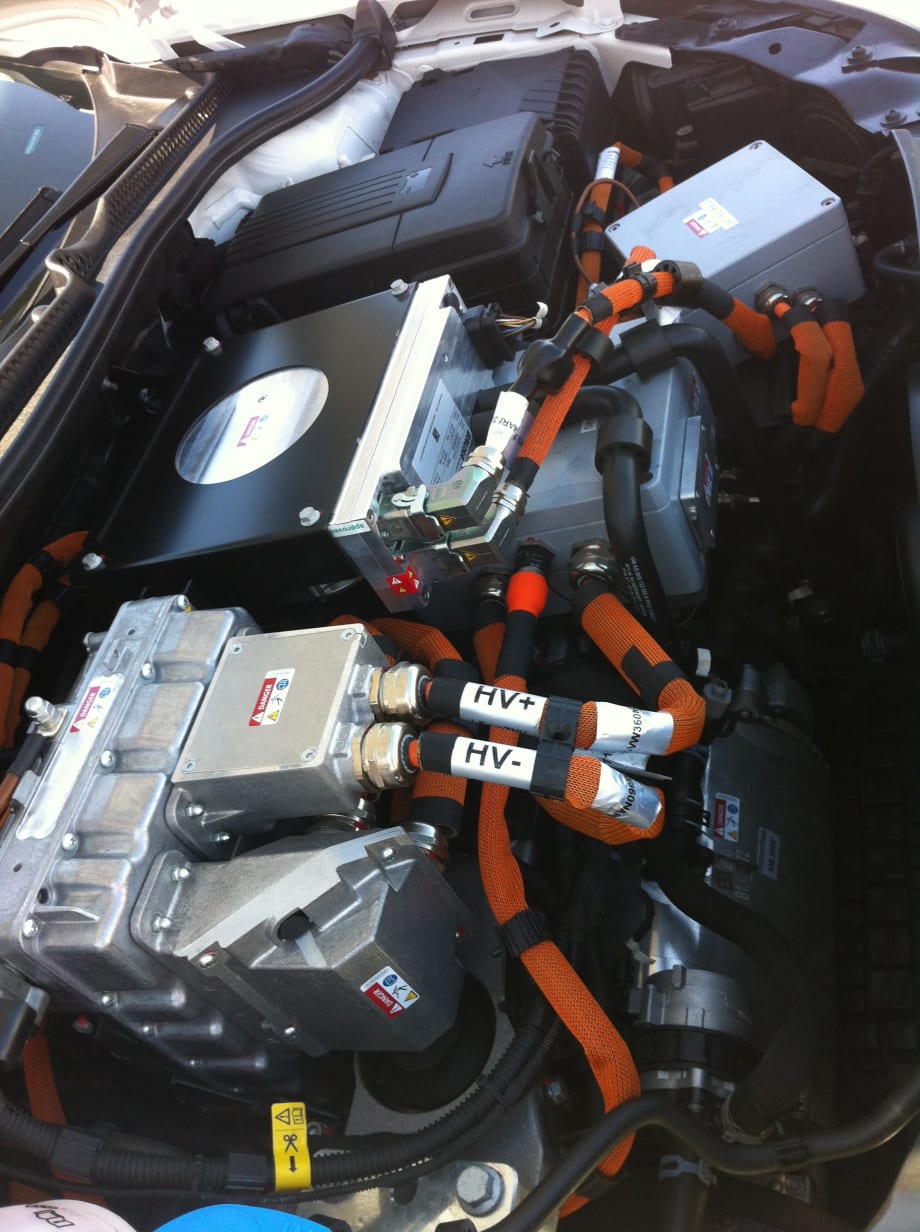
The VW e-Golf has a 26.5Kwh battery for 115 horsepower and 270 lb-ft. of torque, a top speed of 85 mph and a driving range of up to 95 miles, with 65 to 70 miles in “real-world” conditions.
Volkswagen has laid down the gauntlet for its U.S. sales, proclaiming a goal to sell 800,000 vehicles by 2018. At its third annual fleet preview event last week in Las Vegas, Volkswagen laid down its plans to get there.
If 2012 is any indication, the company is on track. Volkswagen Group (including Audi, Bentley, Bugatti and Lamborghini) sold more than 580,000 units in the U.S. last year. That was good for a 3% market share, its best in 29 years stateside.
Globally, Volkswagen had its best year since 1973, selling 9 million vehicles worldwide. VW’s 11.2% growth rate outpaced market-wide sales increases in every market, and in Europe, VW gained share in a shrinking market. VW sold a whopping 2.8 million vehicles in China last year, by far its largest market.
Is VW expecting to outpace these sales gains? “The target this year is to keep a stable position,” said Thomas Meuser, general manager of fleet sales and remarketing at VW, adding that “fleet sales are an essential part of that path” to 800,000 sales.
On that path is the growth of the dealer network. Volkswagen counted 617 dealers in the U.S. in 2012 and will add about 28 dealers by the end of 2013. Increasing dealer capacity is just as important. In 2009, VW dealers sold an average of 368 vehicles; in 2012, that figure nearly doubled to 710 vehicles sold.
Meuser offered some trends that speak positively to fleet concerns such as residual values and order-to-delivery times (OTD). Some 75% of VW’s vehicles sold in the U.S. were sourced in America last year, up from 60% before the Chattanooga, Tenn., plant was opened in 2011 to produce the Passat. The OTD for the Passat is 46 days, one of the lowest averages in fleet. VW OTDs range from 46 to 100 days (Tiguan – 70, Golf and Touareg – 90).
VW is “actively preparing the network to protect residuals,” Meuser said. VW products realize a very high lease share, and at 83%, VW claims the highest CPO (certified, pre-owned) share of any non-luxury automaker, doubling the average. Only 10% of its lease maturities are sold at a physical auction.
The automaker has upped its fleet share in recent years, but intends to keep fleet at 10% of total sales. Since opening its fleet program in the U.S. in 2011, fleet sales have grown 109%, though on small comparative numbers. Rental fleet sales make up the great majority; however, the share of commercial fleet has been taking a bigger piece of the pie. VW will cap rental fleet sales, with no cap on commercial fleet.
This year’s fleet preview put us in between the new model release cycle. But what VW lacked in new product to show off, it made up for by a “powertrain offensive.” VW is debuting three new four-cylinder engines in less than a year.
Late last year the automaker introduced the 1.4L TSI (170 hp) turbocharged hybrid powerplant on the Jetta hybrid and followed that with the new gasoline 2.0L TSI turbo (210 hp) in March. A new 1.8L TDI diesel engine debuts this fall.
Turbo is the name of the game. Whereas turbo was once all about performance, explained Doug Skorupski, manager of product strategy, it’s now about efficiency. The naturally aspirated engine is replaced with direct injection and turbo charging, which allows for an engine displacement reduction without a loss of power or torque. Turbo is standard on the Jetta, a first in the compact segment, and the new 1.8L TSI gets 15% better fuel economy with the same horsepower compared to the outgoing engine. VW claims that in model year 2014, more than 50% of its fleet will have turbo technology.
In terms of new models, VW did show off the all-electric e-Golf, which will hit the market late next year as a 2015 model. Don’t expect fleet sales (not soon).
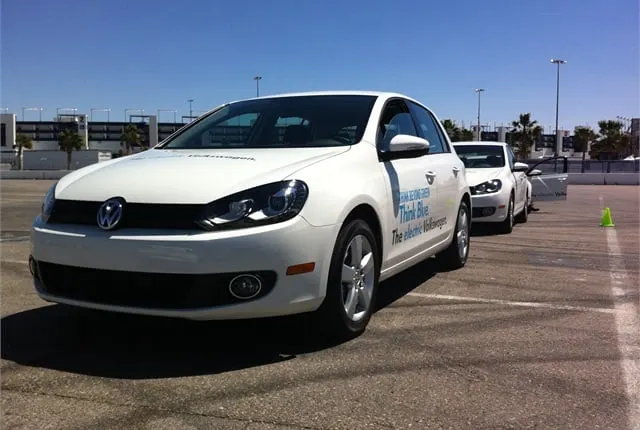
The all-electric Golf Blue e-motion prototype will hit the market late next year as a 2015 model. At present, there are only 80 e-Golfs built worldwide, and seven of them were in Las Vegas for the fleet preview.
The VW e-Golf has a 26.5Kwh battery for 115 horsepower and 270 lb-ft. of torque, a top speed of 85 mph and a driving range of up to 95 miles, with 65 to 70 miles in “real-world” conditions.
But for fleets that want to conserve some carbon dioxide and the fuel bill, Volkswagen has seven diesel models for you. In 2012, VW sold 90,295 diesels for 72% of light-duty diesel market. Take rates for the diesel engine are high: about 50% on the Golf and Touareg, and 86% on the Jetta Sportwagen. Why? Look to a range of 609 to 795 miles, real-world fuel economy figures that exceed EPA numbers and retained values after 36 months that average about four points higher than VW gas models.
Oh, and with diesel, there’s no need to drive “gingerly” to get better MPG. On a road course at the Las Vegas Motor Speedway, we once again got to put VW models to the test. Nothing beats hot-lapping a turbodiesel Golf with a stick, with its aggressive torque and agile cornering. It’s a perk of the job.
More Blog Posts
2021 Ford Transit Offers Versatility for Fleets
For the 2021-MY, Ford made ergonomic enhancements for drivers and added an available Parcel Delivery Package. This follows a major refresh in 2020, which added a Crew version, a new standard engine, standard active safety technologies, and embedded telematics to the Transit van family.
Read More →
Recognizing the Other Essential Drivers
Vocational and business fleet drivers don’t get the attention that truckers do. Yet they too are on the front lines, and their jobs often bring them into uncontrolled environments every day.
Read More →
It’s Time to Formulate an ADAS Game Plan
As proliferation of Advanced Driver Assistance Systems (ADAS) increases, skilled labor, equipment, and training costs will increase as well. Fleet operators can’t mitigate these financial burdens by cutting corners on ADAS recalibration and repairs.
Read More →
The Future is Electric, But…
With an increasing emphasis on emissions reductions mandates, will fleet operators get caught between clean technologies on their way out and an electric future that hasn’t yet arrived?
Read More →
6 Trend Lines from the 2019 Work Truck Show
From giant leaps in torque and towing to heavy duty truck personalization and chassis cab styling, these trends emerged from this year’s Work Truck Show in Indianapolis.
Read More →
They’re Coming for Your Diesel
In Southern California and other parts of the world, regulators are coalescing to ban, or severely curtail, diesel vehicles. There’s a growing disconnect with the mandates to green the environment and the availability of products and technologies to get us there.
Read More →
Hey Cannabis Companies, Welcome to Fleet
An industry is forming, and it needs help with fleet. In the meantime, the fleet industry should know that these new businesses are navigating extraordinary circumstances, which is forcing them to be better fleet operators pretty darn quick.
Read More →
Takeaways from the Fleet Forward Conference
Most attendees — from established fleets and vendors to new players that were only formed five years ago — didn’t know anyone. But that’s exactly the point.
Read More →
Is it Time to Rethink How Drivers Are Paid?
With the ELD rule affecting miles driven, and drivers’ duties increasingly including more than just driving the vehicle, what can be done to more accurately and fairly reflect a driver’s workday?
Read More →
Whatever Happened to CNG?
While the light-duty market for compressed natural gas vehicles has almost evaporated, new near zero emissions technology and drastic reductions in infrastructure costs have reinvigorated the market for medium- and heavy-duty applications — even for smaller fleets.
Read More →