


Trends in the Low-Cab Forward Market
After a day with Isuzu, here are some thoughts on low-cab forward sales, diesel versus gas, and how hard is it to tilt that cab by hand, especially on Isuzu's new Class 6 FTR?

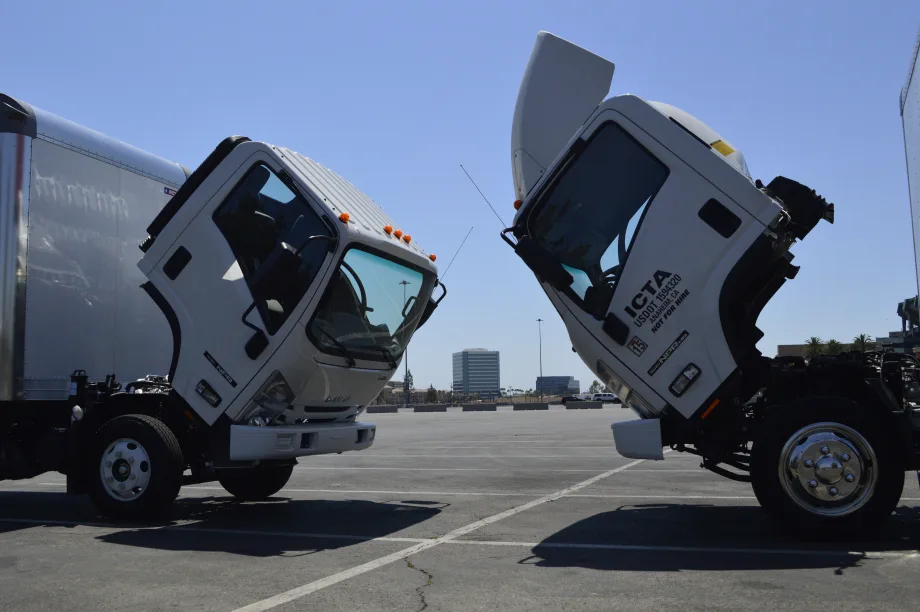
"Bow to your partner." The Isuzu NPR diesel model (left, 12,000 lbs. GVWR) squares off with its gas (13,000 lbs. GVWR) counterpart.
One of the benefits of low-cab forward (LCF or “cabover”) trucks is the ease in which they are serviced — you literally tilt the cab forward by hand to reveal the engine. There’s a lot less leaning, stepping, and neck craning than servicing traditional medium-duty trucks. That is, if you can actually tilt the cab.
To answer that question — and others — Business Fleet spent a day kicking (and spinning) tires with Isuzu Commercial Truck of America and two of its Class 3 NPR models, one with a gas powerplant (14,500 lb. GVWR) and the other with diesel (13,000 lb. GVWR). We also got a chance to get up close to Isuzu’s new Class 6 FTR model, though we didn’t get to drive it.
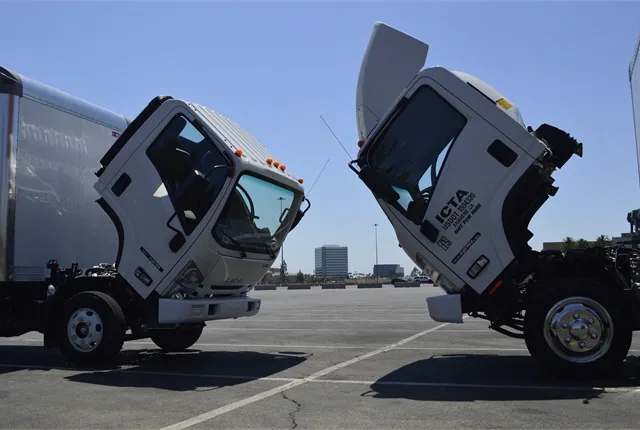
"Bow to your partner." The Isuzu NPR diesel model (left, 12,000 lbs. GVWR) squares off with its gas (13,000 lbs. GVWR) counterpart.
Isuzu plans to build 40% more gas N-Series trucks this year over 2015, said Brian Tabel, executive director of marketing for Isuzu Commercial Truck of America. Registrations for all LCF makes and models in GVW Classes 3 to 5 are on a six-year high, according to Isuzu’s competitive volume analysis. (Isuzu owns more than 80% of the U.S. LCF market, which also includes Hino and Mitsubishi.) Tabel said pent-up demand is driving some of the spike.
Another factor driving LCF sales is the more long-term trend to urbanization in the U.S. With tight turning radiuses, LCFs perform particularly well in urban environments. Also benefitting urban driving, a cabover’s view from the cockpit is only 8 feet to the ground, compared to 27 feet on a traditional truck nose. As of the 2013 model year, Isuzu’s transmissions are all automatic, making stop-and-go city driving easier.
In terms of the bodies sitting on LCF chasses, the trend is to aluminum — for better fuel economy and the weight savings goes straight to payload.
The move away from diesel-powered trucks to gas is alive and well in the LCF market, too. Within Isuzu’s N-Series family, there’s an $8,000 to $10,000 upfront premium on the diesel powerplant over gas models. Combine that with overall low fuel prices in the U.S. today, total cost of ownership (TCO) of a gas-powered truck works out favorably compared to diesel.
And “diesel fatigue” may be a factor as well. Since the mandate for diesel particulate filters (DPFs) in 2008, operators have found the extra maintenance and unexpected servicing to be a costly hassle. And yes, some have been angling for a Darwin Award for putting the wrong fluid in the diesel exhaust fluid (DEF) reservoir. (For an analysis of DPF headaches, visit this article at or sister publication, Heavy Duty Trucking.)
All told, the diesel versus gas question still comes down to use case and total mileage. If you’re running heavy delivery routes and 30,000 miles a year and up, diesel’s fuel economy benefit starts to pay off. Tabel said real-world fuel economy numbers come in at 7 to 12 mpg for gas models and 10 to 16 mpg for diesel, depending, of course, on the infinite variety of truck bodies and use cases. With greater payload needs or a trailer on back, diesel makes more sense.
For trades such as construction and landscaping, generally running fewer than 25,000 miles a year, gas would be a better bet from a TCO standpoint.
For more photos of Isuzu's NPR models, visit this gallery.
Along our drive course, both gas and diesel NPR models were easy to drive and maneuver, even for the first-time cabover drivers in our group. The Vortec sourced 6.0-liter V-8 gas engine literally leapt up hills and from dead stops, while the four-cylinder diesel took its time with the pedal to the floor. We weren’t carrying a load, and that’s where the traditional torque of diesel would’ve made up some of the difference.
Back to the reason for the name — cabover — and being able to tilt that compartment to service the engine. How hard is it, really? It’s all about leverage. Full disclosure, I weigh a lean 158 lbs. and I had no problem pulling open and then closing the cab on the diesel model.
The gas model, however, had a wind fairing on top of the cab, which added 125 lbs. that was distributed away from the fulcrum, making it even harder to pull forward and down. I managed, ultimately, also noting that your standard cabover technician is well prepared for these situations.
Not surprisingly, the LCF crew cab models don’t tilt at all. The engines are accessed through three entry points in front of and inside the cab.
This brings us to Isuzu’s new FTR model, launched at the Work Truck Show in March. Rated at 26,000 lbs. GVWR, it’s a true Class 6 hauler. Yes, the cab is larger and heavier. But the fulcrum is placed at a pivot point that allows its weight to help the operator pull it both open and shut. In other words, I had no problem at all.
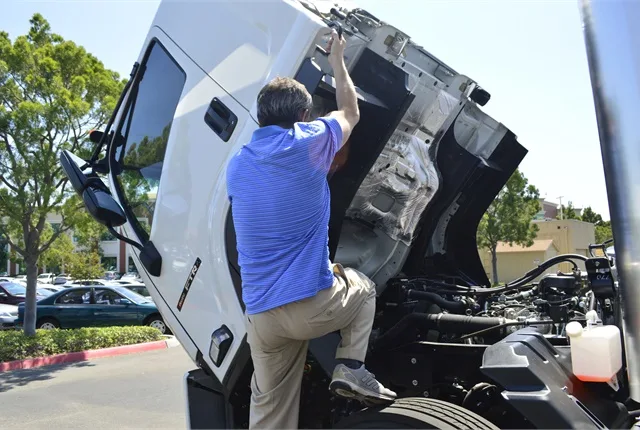
At 26,000 lbs. GVWR, the cab of Isuzu's new Class 6 FTR was still fairly easy to open and close.
More Blog Posts
2021 Ford Transit Offers Versatility for Fleets
For the 2021-MY, Ford made ergonomic enhancements for drivers and added an available Parcel Delivery Package. This follows a major refresh in 2020, which added a Crew version, a new standard engine, standard active safety technologies, and embedded telematics to the Transit van family.
Read More →
Recognizing the Other Essential Drivers
Vocational and business fleet drivers don’t get the attention that truckers do. Yet they too are on the front lines, and their jobs often bring them into uncontrolled environments every day.
Read More →
It’s Time to Formulate an ADAS Game Plan
As proliferation of Advanced Driver Assistance Systems (ADAS) increases, skilled labor, equipment, and training costs will increase as well. Fleet operators can’t mitigate these financial burdens by cutting corners on ADAS recalibration and repairs.
Read More →
The Future is Electric, But…
With an increasing emphasis on emissions reductions mandates, will fleet operators get caught between clean technologies on their way out and an electric future that hasn’t yet arrived?
Read More →
6 Trend Lines from the 2019 Work Truck Show
From giant leaps in torque and towing to heavy duty truck personalization and chassis cab styling, these trends emerged from this year’s Work Truck Show in Indianapolis.
Read More →
They’re Coming for Your Diesel
In Southern California and other parts of the world, regulators are coalescing to ban, or severely curtail, diesel vehicles. There’s a growing disconnect with the mandates to green the environment and the availability of products and technologies to get us there.
Read More →
Hey Cannabis Companies, Welcome to Fleet
An industry is forming, and it needs help with fleet. In the meantime, the fleet industry should know that these new businesses are navigating extraordinary circumstances, which is forcing them to be better fleet operators pretty darn quick.
Read More →
Takeaways from the Fleet Forward Conference
Most attendees — from established fleets and vendors to new players that were only formed five years ago — didn’t know anyone. But that’s exactly the point.
Read More →
Is it Time to Rethink How Drivers Are Paid?
With the ELD rule affecting miles driven, and drivers’ duties increasingly including more than just driving the vehicle, what can be done to more accurately and fairly reflect a driver’s workday?
Read More →
Whatever Happened to CNG?
While the light-duty market for compressed natural gas vehicles has almost evaporated, new near zero emissions technology and drastic reductions in infrastructure costs have reinvigorated the market for medium- and heavy-duty applications — even for smaller fleets.
Read More →