


Driver Distractions Extend 27 Seconds Beyond Act
New research from the AAA Foundation for Traffic Safety concludes that drivers’ mental distractions can persist long after completing a task.

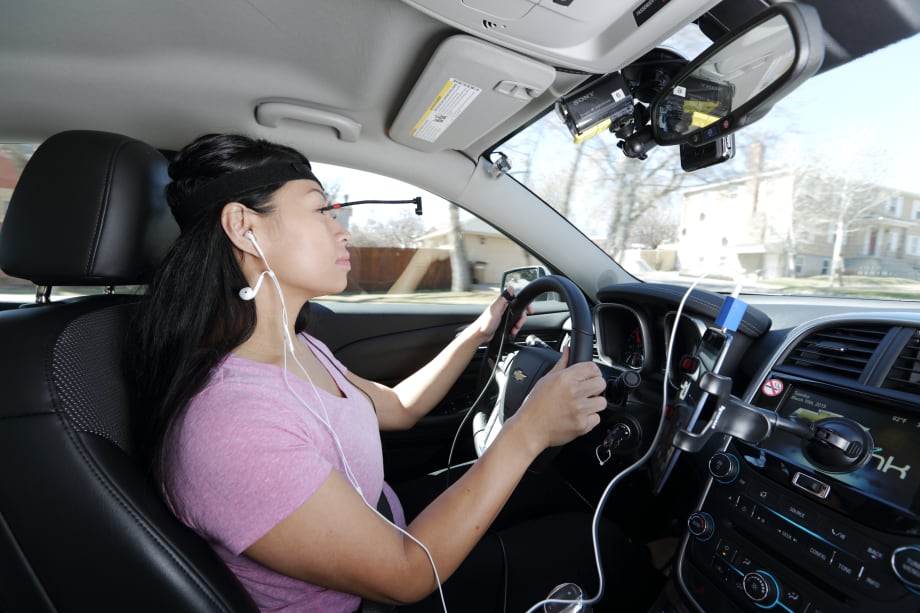
Drivers participated in a test aimed at gauging mental distractions presented by new hands-free technologies.
Photo courtesy of AAA.
Drivers participated in a test aimed at gauging mental distractions presented by new hands-free technologies. Photo courtesy of AAA.
Potentially unsafe mental distractions can persist for as long as 27 seconds after a driver dials, changes music or sends a text using voice commands, according to new research by the AAA Foundation for Traffic Safety.
The study results raise new and unexpected concerns regarding the use of phones and vehicle information systems while driving, the foundation said. This research represents the third phase of the foundation’s investigation into cognitive distraction. Results show that new hands-free technologies can mentally distract drivers even if their eyes are on the road and their hands are on the wheel.
“The lasting effects of mental distraction pose a hidden and pervasive danger that would likely come as a surprise to most drivers,” said Peter Kissinger, president and CEO of the AAA Foundation for Traffic Safety. “The results indicate that motorists could miss stop signs, pedestrians and other vehicles while the mind is readjusting to the task of driving.”
Researchers found that potentially unsafe levels of mental distraction can last for as long as 27 seconds after completing a distracting task in the worst-performing systems studied. At the 25 mph speed limit in the study, drivers traveled the length of nearly three football fields during this time. When using the least distracting systems, drivers remained impaired for more than 15 seconds after completing a task.
“Drivers should use caution while using voice-activated systems, even at seemingly safe moments when there is a lull in traffic or the car is stopped at an intersection,” said Marshall Doney, AAA’s president and CEO. “The reality is that mental distractions persist and can affect driver attention even after the light turns green.”
The researchers discovered the residual effects of mental distraction while comparing new hands-free technologies in 10 2015 model-year vehicles and three types of smart phones. The analysis found that all systems studied increased mental distraction to potentially unsafe levels. The systems that performed best generally had fewer errors, required less time on task and were relatively easy to use.
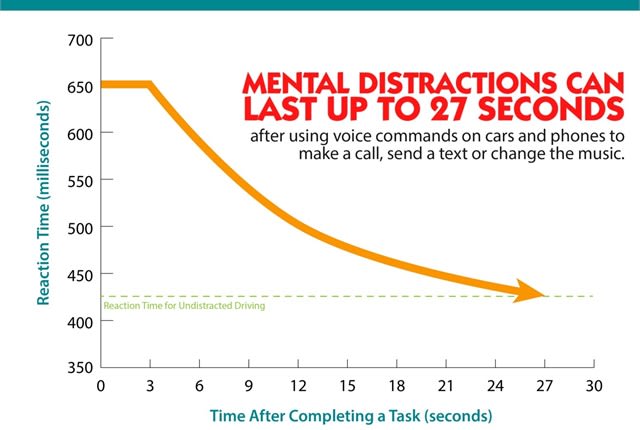
Source: AAA Foundation for Traffic Safety
The researchers rated mental distraction on a five-point scale. Category one represents a mild level of distraction and category five represents the maximum. AAA considers a mental distraction rating of two and higher to be potentially dangerous while driving.
The best performing system was the Chevy Equinox with a cognitive distraction rating of 2.4, while the worst performing system was the Mazda 6 with a cognitive distraction rating of 4.6, researchers found. Among phone systems, Google Now performed best with a distraction rating of 3.0, while Apple Siri and Microsoft Cortana drew ratings of 3.4 and 3.8.
Using the phones to send texts significantly increased the level of mental distraction. While sending voice-activated texts, Google Now rated as a category 3.3 distraction, while Apple Siri and Microsoft Cortana rated as category 3.7 and category 4.1 distractions, respectively.
“The massive increase in voice-activated technologies in cars and phones represents a growing safety problem for drivers,” Doney said. “We are concerned that these new systems may invite driver distraction, even as overwhelming scientific evidence concludes that hands-free is not risk free.”
Previous AAA Foundation research established that a category 1 mental distraction is about the same as listening to the radio or an audio book. A category 2 distraction is about the same as talking on the phone, while category 3 is equivalent to sending voice-activated texts on a perfect, error-free system. Category 4 is similar to updating social media while driving, while category 5 corresponds to a highly challenging scientific test designed to overload a driver’s attention.
“Developers should aim to reduce mental distractions by designing systems that are no more demanding than listening to the radio or an audiobook,” Doney said. “Given that the impairing effects of distraction may last much longer than people realize, AAA advises consumers to use caution when interacting with these technologies while behind the wheel.”
Dr. David Strayer and Dr. Joel Cooper of the University of Utah conducted the research. A total of 257 drivers ages 21-70 participated in the study of 2015 model-year vehicles, while 65 additional drivers ages 21-68 tested the three phone systems.
Originally posted on Automotive Fleet
More Safety
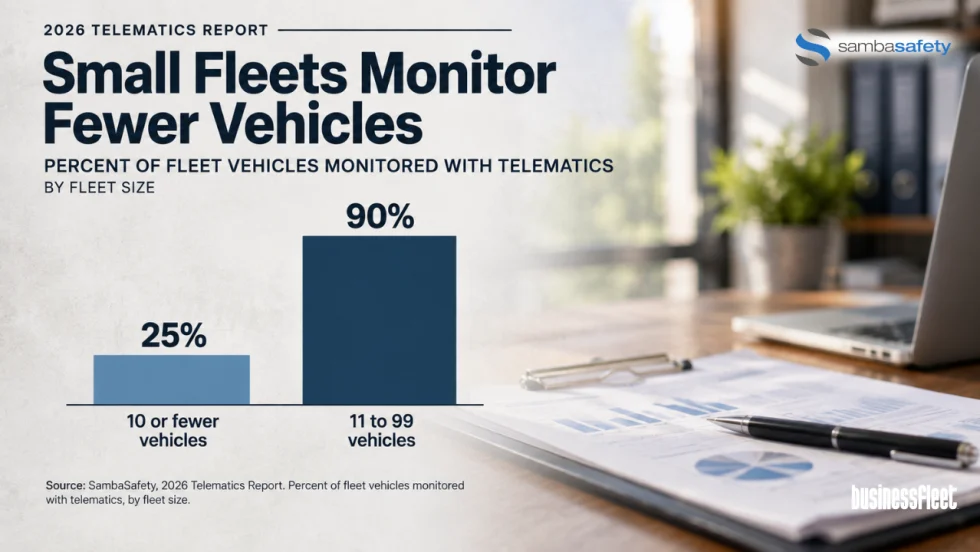
Small Fleets Lag in Telematics Coverage as Industry Moves Beyond Adoption
SambaSafety’s 2026 Telematics Report finds fleets with 10 or fewer vehicles monitor a much smaller share of their vehicles than larger operations, as the industry shifts its focus from collecting data to using it.
Read More →
Back-to-School Traffic Is Not the Risk Fleets Think It Is
Back-to-school traffic does not always mean more crashes. New Empiric Earth data shows why fleets should focus on when and where risk changes.
Read More →
Small Fleet, Big Exposure: How to Reduce Workers’ Comp Risks
For small fleets, one crash can trigger far more than vehicle damage. Here’s how stronger driver safety policies, training, maintenance, and technology can help reduce workers’ comp exposure.
Read More →
Who Makes the Call When Winter Weather Gets Dangerous?
Winter weather can quickly change a small fleet’s plans. Knowing when to reroute, delay, or stop can matter just as much as preparing the vehicles themselves.
Read More →
API Issues Refueling Safety Guidelines
The American Petroleum Institute offers a list of safe vehicle refueling guidelines, including ways to avoid potential problems with static electricity discharges in fall, winter, and early spring.
Read More →
Winter Fleet Prep: Expert Tips to Keep Vehicles Running Smoothly
Cold weather can expose weak batteries, tires, fuel systems, and maintenance gaps fast. Use this winter fleet checklist to prepare trucks and drivers before temperatures drop.
Read More →
8 ADAS Maintenance Tips for Small Business Fleets From Bendix
A dirty camera, bad alignment, or one loose connection could quietly knock your fleet’s ADAS offline. Here’s what Bendix says to check.
Read More →
Developing Budget-Friendly Driver Safety Programs
From driver training and safety meetings to one-on-one coaching and incentive programs, several small fleets share how they have developed a safety culture with their drivers using low- to no-cost resources.
Read More →
A 20-Minute Safety Check for Small Fleets Before Operation Safe Driver Week
No safety department? No problem. Here's a practical checklist small fleet managers can use before Operation Safe Driver Week begins.
Read More →
Why Small Fleets Keep Getting Tripped Up by ELD Compliance
Roadcheck revealed a hard truth: most ELD violations aren't intentional. They're caused by small mistakes that can cost fleets time, money, and trust.
Read More →