


Safety Tip: Driving Near Rail Crossings
September is National Rail Safety Month, so now is a good time to review some driving safety advice concerning railroad crossings.

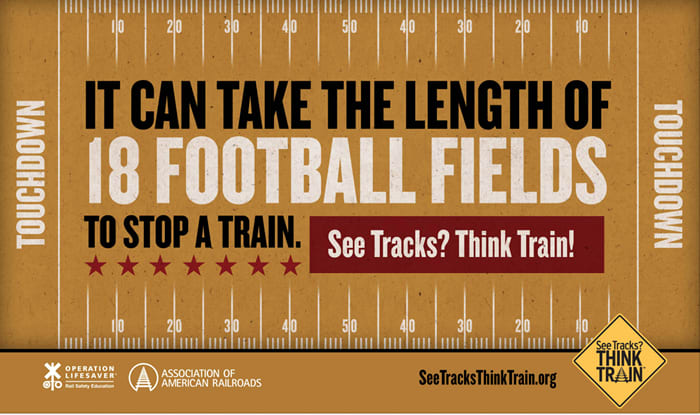
September is National Rail Safety Month, so now is a good time to review some driving safety tips concerning railroad crossings.
Railroad crossings continue to be dangerous places, despite public service campaigns intended to educate the driving public. In 2015, there were 2,059 vehicle-train collisions in the U.S., according to preliminary data from the Federal Railroad Administration. These crashes resulted in 244 deaths and 967 injuries.
Here’s advice — culled from the Indiana Department of Transportation and California Department of Transportation — that you can pass along to fleet drivers as a friendly reminder:
Look in both directions and listen for trains when signs indicate you're approaching a rail crossing. Keep in mind that In rural areas, not all crossbucks have flashing lights and gates that come down. Cross only when it's safe to do so.
Never stop on railroad tracks. Remember that a train cannot stop quickly or swerve out of the way. If you're stopped on the tracks, you risk injury or death.
Watch for vehicles that must stop before they cross train tracks. These vehicles include buses, school buses, and trucks transporting hazardous loads.
Remember that flashing red traffic signal lights mean STOP! Stop at least 20 feet, but no more than 50 feet, from the nearest track. Always stop if you see a train coming or you hear the whistle, horn, or bell of an approaching train.
Never go under lowering gates or around lowered gates. Flashing red warning lights indicate you must stop and wait. Don't proceed over the railroad tracks until the red lights stop flashing, even if the gate rises. If the gates are lowered and you don't see a train approaching, call the posted railroad emergency toll-free number or 9-1-1. Be ready to give a detailed description of your location.
Always expect a train. Trains don’t run on set schedules. They can be on any track, at any time, going in either direction. When locomotive engineers see a vehicle or person on the tracks in the path of their train, they can only sound the warning horn and apply the emergency brakes. A train in emergency braking will stop, but not in time to avoid this collision. The average freight train takes over a mile to stop in emergency braking.
Always yield the right of way to the train. The train cannot yield to you. More than half of all motor vehicle-train collisions occur at crossings equipped with automatic signals. It’s because some drivers choose to drive around the gates or through flashing red lights because they think they can beat the train or they assume either a stopped train has activated the signals or the signals are malfunctioning.
Never ignore active warnings at crossings because of what you think you see. Locomotives are huge — 17 feet high and 10 feet wide. As a result, they appear to be traveling much slower than you think when viewed from a slight angle at the crossing. The combination of the size and angle creates this illusion. The parallel lines of the rails converging toward the horizon contribute to the illusion and fool your mind into thinking the train is farther away than it actually is.
Keep in mind that trains will arrive at a crossing faster than you anticipate. One in four crashes occurring at highway-rail crossings takes place when drivers run into the side of the train. Often, it’s because the driver is traveling too fast for conditions, such as darkness, rainy weather, or fog. Also, many drivers “overdrive their headlights” — drive too fast to be able to stop in the distance illuminated.
Don't try to pass another vehicle when you see advance-warning signs indicating a rail-highway crossing ahead. The vehicle being passed may obstruct a clear view of the tracks, or vehicle speed while passing may be too great to stop in time.
Before starting across the tracks, be sure there's room to get completely across. Many crossings are on a surface higher than the roadway. Shifting gears with a manual transmission while going across this raised surface may cause the vehicle to stall on the tracks. If your vehicle is ever stalled or trapped on the tracks and a train is approaching, quickly get yourself and all other passengers out! Don’t try to take any other items with you.
When running away from a vehicle stuck on tracks, run away from the tracks at an angle in the direction of the approaching train. When the train strikes the vehicle, it will send flying metal and glass ahead of and outward from the locomotive. If a train is not approaching when a vehicle is stuck on the tracks, you still need to get yourself and all other passengers out of the vehicle and to a safe location. At crossings there are signs with a toll-free number to call the railroad directly and warn employees of stalled vehicles or other problems at the crossing.
When a crossing has more than one track, don’t try to cross immediately after the end of the train passes — there may be another train approaching on the second track. Many crossing crashes have resulted because of impatience or inattentiveness at multiple-track crossings. You’ll always know how many tracks are at the crossing by observing a sign posted under the crossbuck.
Originally posted on Automotive Fleet
More Safety
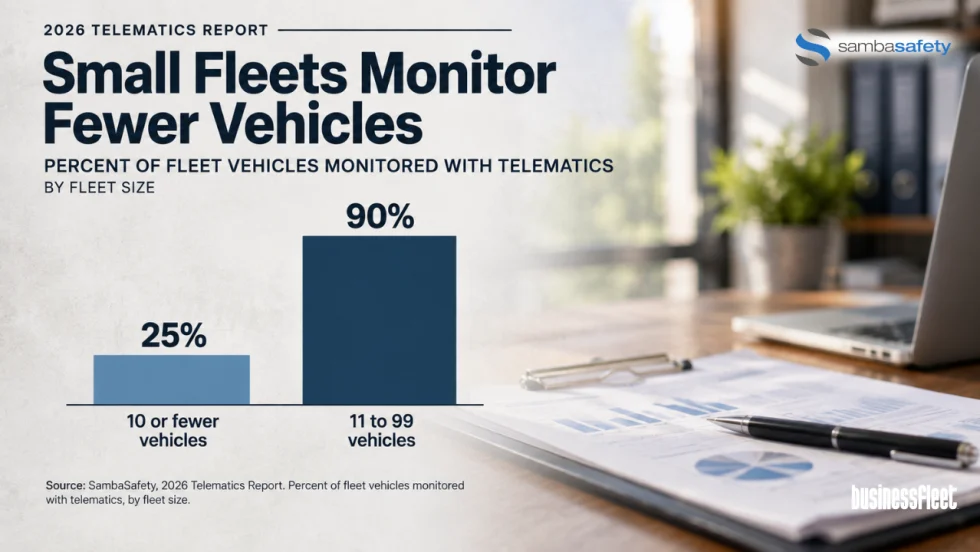
Small Fleets Lag in Telematics Coverage as Industry Moves Beyond Adoption
SambaSafety’s 2026 Telematics Report finds fleets with 10 or fewer vehicles monitor a much smaller share of their vehicles than larger operations, as the industry shifts its focus from collecting data to using it.
Read More →
Back-to-School Traffic Is Not the Risk Fleets Think It Is
Back-to-school traffic does not always mean more crashes. New Empiric Earth data shows why fleets should focus on when and where risk changes.
Read More →
Small Fleet, Big Exposure: How to Reduce Workers’ Comp Risks
For small fleets, one crash can trigger far more than vehicle damage. Here’s how stronger driver safety policies, training, maintenance, and technology can help reduce workers’ comp exposure.
Read More →
Who Makes the Call When Winter Weather Gets Dangerous?
Winter weather can quickly change a small fleet’s plans. Knowing when to reroute, delay, or stop can matter just as much as preparing the vehicles themselves.
Read More →
API Issues Refueling Safety Guidelines
The American Petroleum Institute offers a list of safe vehicle refueling guidelines, including ways to avoid potential problems with static electricity discharges in fall, winter, and early spring.
Read More →
Winter Fleet Prep: Expert Tips to Keep Vehicles Running Smoothly
Cold weather can expose weak batteries, tires, fuel systems, and maintenance gaps fast. Use this winter fleet checklist to prepare trucks and drivers before temperatures drop.
Read More →
8 ADAS Maintenance Tips for Small Business Fleets From Bendix
A dirty camera, bad alignment, or one loose connection could quietly knock your fleet’s ADAS offline. Here’s what Bendix says to check.
Read More →
Developing Budget-Friendly Driver Safety Programs
From driver training and safety meetings to one-on-one coaching and incentive programs, several small fleets share how they have developed a safety culture with their drivers using low- to no-cost resources.
Read More →
A 20-Minute Safety Check for Small Fleets Before Operation Safe Driver Week
No safety department? No problem. Here's a practical checklist small fleet managers can use before Operation Safe Driver Week begins.
Read More →
Why Small Fleets Keep Getting Tripped Up by ELD Compliance
Roadcheck revealed a hard truth: most ELD violations aren't intentional. They're caused by small mistakes that can cost fleets time, money, and trust.
Read More →