


The Truth Behind Compact Van Depreciation
Why are large van values holding up better than their compact counterparts, and will it last?


The numbers from Black Book are eye-opening: Compact vans are among the worst depreciating segments, with annual depreciation for a two- to- six-year-old van at more than 23%. On the other hand, depreciation for full-size vans in this time period is less than 13%. Pickup trucks have fared even better.
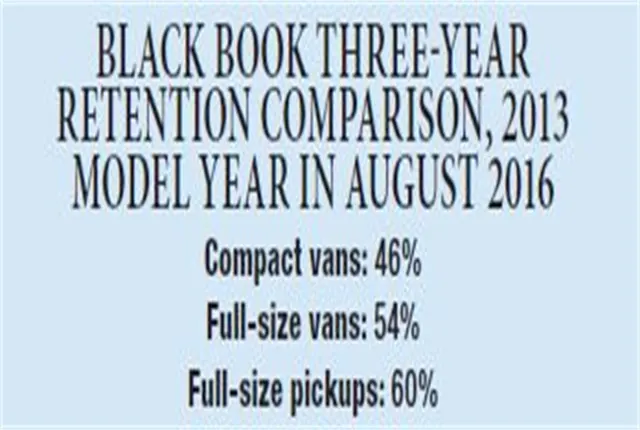
While strong value retention for pickups is well known, it’s worth digging into the reasons behind compact vans’ recent poor performance. For analysis, we turn to Jeb Lopez, owner of Wheelz Up, an auto parts delivery service in the D.C. metro area, and Brad Jacobs, director of strategic consulting for Merchants Fleet Management.
Wheelz Up, which puts 30,000 miles on its vans in a year, runs both the larger Ford Transit and Nissan NV models as well as the Transit Connect and NV200 compact vans. Lopez says selling larger vans is easier than the compact ones because the large vans are in high demand, particularly by construction companies and contractors.
While the larger vans cost $5,000 to $10,000 more than their compact counterparts out of the gate, the monthly cost differential on a lease or finance is about $100 to $150. By moving up to a larger van, that $150 buys you more than double the payload capacity and cargo volume.
As well, the myriad of configurations in the large vans — roof heights, door configurations, engines, storage options, and weight ratings — play a factor. “A lot of people have been gravitating to the Euro-style vans that might have used a pickup truck in the past simply because they are more versatile,” Jacobs says.
Fuel economy does make a difference: Wheelz Up is averaging about 13 to 14 mpg on the larger vans and 17 mpg on the smaller ones. That’s a noticeable chasm, though the recent trend to low fuel prices has softened the blow. Moreover, Lopez says that his smaller vans have seen higher maintenance costs with brake and tire wear. “We don’t get that on the (larger) cargo vans,” he says.
Jacobs agrees that lower fuel prices haven’t helped residuals for the compact vans, though he maintains that wear and tear on any vehicle is utilization and application specific.
In terms of spec’ing for the application, no one wants to use a larger van at half capacity, and Lopez has been caught in this circumstance before. He then switched to a smaller van for the same run. “However, we noticed that we were helping to build (this client’s) business, and after six to eight months, they were buying more from us — and we were switching back to the bigger cargo vans,” he says. This ability to scale upward seems to play into the hands of larger vans as well.
Nonetheless, Lopez believes that the compact van’s place in the market is solid: “They’re easier to drive, they get better fuel economy, and parking in the city is more forgiving,” he says.
Jacobs concurs, saying that there are plenty of applications in which adding payload and capacity don’t make sense, because the company’s product needs fit the smaller vans. And these new van models have given fleets the flexibility to right-size. “Where they were using a pickup truck, they can now spec a compact utility van,” he says.
This portends another trend. “Over time, we’ll see an impact to light trucks with service bodies,” Jacobs says, adding that the new cargo vans have racks and bin packages that serve traditional service body applications. Spec’ing a van in this way is cheaper than a truck with a service body, and it’s more resale friendly.
Jacobs points out another factor that works in small van’s favor: In 2013, the only compact van was the Ford Transit Connect, so the market today essentially offers only one used compact van choice.
Moreover, the Transit Connect was redesigned for the 2014 model year, offering two wheelbase choices, a passenger wagon version, and a more powerful engine that maintains good fuel economy.
New model choices, such as the Nissan NV200, Chevrolet City Express, and Ram ProMaster City, along with a redesigned Transit Connect, should boost pricing in auction lanes in coming years.
More Blog Posts

2021 Ford Transit Offers Versatility for Fleets
For the 2021-MY, Ford made ergonomic enhancements for drivers and added an available Parcel Delivery Package. This follows a major refresh in 2020, which added a Crew version, a new standard engine, standard active safety technologies, and embedded telematics to the Transit van family.
Read More →
Recognizing the Other Essential Drivers
Vocational and business fleet drivers don’t get the attention that truckers do. Yet they too are on the front lines, and their jobs often bring them into uncontrolled environments every day.
Read More →
It’s Time to Formulate an ADAS Game Plan
As proliferation of Advanced Driver Assistance Systems (ADAS) increases, skilled labor, equipment, and training costs will increase as well. Fleet operators can’t mitigate these financial burdens by cutting corners on ADAS recalibration and repairs.
Read More →
The Future is Electric, But…
With an increasing emphasis on emissions reductions mandates, will fleet operators get caught between clean technologies on their way out and an electric future that hasn’t yet arrived?
Read More →
6 Trend Lines from the 2019 Work Truck Show
From giant leaps in torque and towing to heavy duty truck personalization and chassis cab styling, these trends emerged from this year’s Work Truck Show in Indianapolis.
Read More →
They’re Coming for Your Diesel
In Southern California and other parts of the world, regulators are coalescing to ban, or severely curtail, diesel vehicles. There’s a growing disconnect with the mandates to green the environment and the availability of products and technologies to get us there.
Read More →
Hey Cannabis Companies, Welcome to Fleet
An industry is forming, and it needs help with fleet. In the meantime, the fleet industry should know that these new businesses are navigating extraordinary circumstances, which is forcing them to be better fleet operators pretty darn quick.
Read More →
Takeaways from the Fleet Forward Conference
Most attendees — from established fleets and vendors to new players that were only formed five years ago — didn’t know anyone. But that’s exactly the point.
Read More →
Is it Time to Rethink How Drivers Are Paid?
With the ELD rule affecting miles driven, and drivers’ duties increasingly including more than just driving the vehicle, what can be done to more accurately and fairly reflect a driver’s workday?
Read More →
Whatever Happened to CNG?
While the light-duty market for compressed natural gas vehicles has almost evaporated, new near zero emissions technology and drastic reductions in infrastructure costs have reinvigorated the market for medium- and heavy-duty applications — even for smaller fleets.
Read More →