



The technology aims to help smaller fleets act on operational data without adding staff or increasing administrative workloads.
Can AI Agents Help Small Work Truck Fleets Do More With Less?
Motive's new AI Agents automate fleet safety, maintenance, compliance, and dispatch tasks. Here's how they work for smaller fleets, what managers control, and what early users are seeing.
October 20, 2026
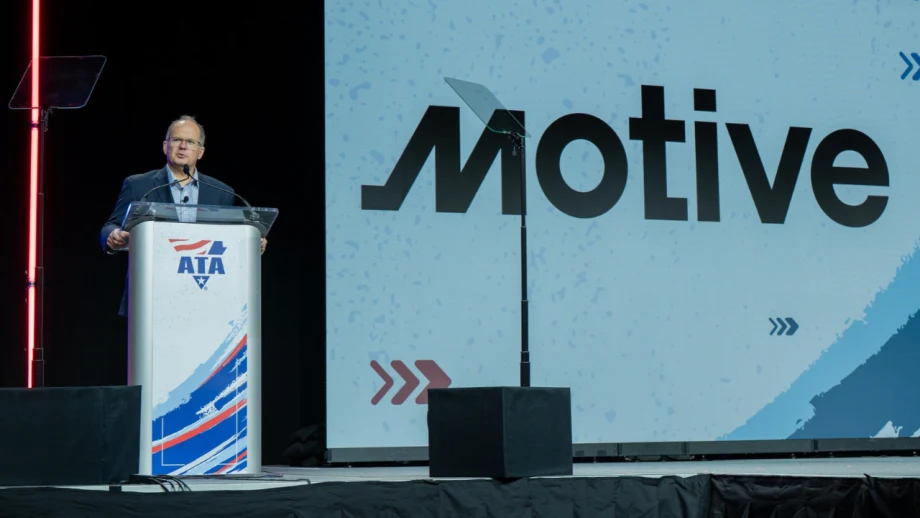
Motive introduced its new AI Agents at the American Trucking Associations' 2026 Management Conference & Exhibition in Charlotte, North Carolina. The technology is designed to help commercial fleets automate safety, maintenance, compliance, and other operational tasks.
Credit:
Motive
9 min to read
For a commercial fleet operating 10, 25, or 50 trucks, managing daily operations often means wearing several hats. The same person responsible for dispatch may also be tracking maintenance schedules, reviewing driver safety events, and making sure vehicles stay compliant. The data to identify problems may already be available, but finding the time to act on it is another challenge.
Motive is looking to address that gap with the launch of Agents, a new AI-powered capability designed to automatically respond to fleet operational data. Rather than simply notifying a manager when something needs attention, Agents can initiate actions such as assigning driver training, opening maintenance work orders, monitoring Hours of Service (HOS) limits, and notifying dispatch when vehicles arrive at or leave job sites.
The technology is designed for fleets of different sizes, but what does it mean for smaller commercial operations that don't have dedicated safety, maintenance, or dispatch departments?
Work Truck spoke with Emily Parsons, staff product manager at Motive, who told us the technology is intended to help smaller fleets manage many of the same operational challenges as larger organizations, without requiring additional staff.
"The same AI that helps a 5,000-truck enterprise catch problems before they happen works just as well for a 10-truck fleet," Parsons said. "That's the whole idea behind Motive Agents. They give smaller teams the reach of a much larger operation, without adding headcount. They work in the background, around the clock, to catch issues early and act on them right away."
Where AI Agents Fit Into Smaller Fleet Operations
For fleets without dedicated personnel overseeing every part of the operation, routine follow-up can consume a significant portion of the workday. A driver safety event may require reviewing footage, contacting the driver, assigning training, and documenting the interaction. A vehicle inspection may identify a defect that needs to be entered into a maintenance system before anyone can schedule repairs.
Agents are designed to automate some of those steps based on conditions established by the fleet.
"Where this really matters is when a business is lean and doesn't have dedicated teams for each function," Parsons explained. "Agents take on the routine follow-up those teams would normally handle by hand."
According to Parsons, potential applications for smaller work truck fleets include:
- Driver safety: When a driver has repeated risky driving events, an Agent can automatically assign training, helping maintain consistent coaching even without a dedicated safety manager.
- Maintenance: Agents can flag upcoming or overdue service and open work orders when vehicle inspections identify defects.
- Dispatch: Automated notifications can alert office personnel when a truck arrives at or leaves a job site, reducing the need for manual check calls.
- Compliance: Agents can warn drivers as they approach their HOS limits, allowing them to take action before a violation occurs.
- Fuel efficiency: When a vehicle exceeds an established idling threshold, Agents can prompt the driver to shut off the engine. The system accounts for ambient temperature to avoid flagging necessary idling during extreme heat or cold.
For a plumbing contractor managing 15 service vans or a construction company operating 40 pickups and medium-duty trucks, these capabilities could reduce the number of routine tasks requiring manual attention.
That doesn't mean every fleet needs every available Agent. A local service fleet may find the greatest value in maintenance reminders and job-site notifications, while a regional operation with HOS-regulated drivers may prioritize compliance monitoring.
Parsons said the setup process is intended to be straightforward.
"Setup is simple: pick a template, choose what it watches for, and turn it on. No technical skills needed," she said. "That's by design. We built Agents to scale from a handful of vans to a multi-thousand-vehicle enterprise, because the operational gap is the same at every size. You can see the problem, but you can't always act on it fast enough."
Agents are available to existing Motive customers and are included in current Motive plans, although certain premium actions are offered as add-ons. Fleets should confirm which capabilities are included in their subscriptions before implementing new workflows.
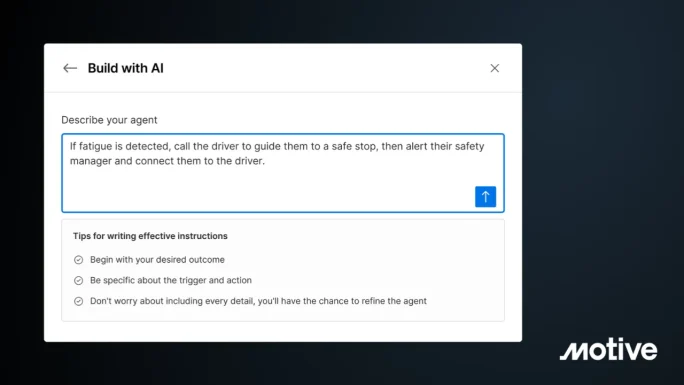
Motive's planned natural-language Agent builder will allow fleet managers to describe an operational task, such as responding to driver fatigue, and create an automated workflow. The feature is expected in early 2027, expanding on the rule-based Agents available today.
Credit:
Motive
A 35-Vehicle Contractor Cuts HOS Violations by 88%
One of the more relevant early examples for smaller commercial fleets comes from a commercial and industrial fencing and highway guardrail contractor operating 35 vehicles.
According to Parsons, the contractor implemented an HOS monitoring Agent designed to notify drivers as they approach their available driving limits. Rather than issuing a single warning at the last minute, the company established a series of notifications that become more urgent as the limit approaches.
At 60 minutes before the limit, the driver receives an in-cab voice message. At 30 minutes, both the driver and their coach receive a notification.
"What I love about this one is that it creates a real buffer zone: 60 minutes to navigate traffic, find safe parking, and pull over legally," Parsons said. "And because most drivers self-correct after that first voice message, managers aren't drowning in alerts."
The contractor reported that monthly HOS violations declined from approximately 85 to 10 in September, an 88% reduction.
"The results speak for themselves," Parsons said.
While the example comes from one fleet and does not establish what other operations should expect, it illustrates how automated notifications can support compliance without requiring managers to continuously monitor driver hours.
For work truck fleets with drivers operating under HOS regulations, the ability to provide earlier warnings may be particularly useful when routes involve changing job sites, traffic delays, or limited parking options.
What Happens When an Agent Makes the Wrong Call?
Automating fleet decisions raises an important question: How much control does the fleet manager retain? For example, Motive describes a maintenance workflow in which an Agent can identify a fault code, open a work order, and mark a vehicle out of service. For a small business relying on every available truck, an unnecessary out-of-service designation could disrupt an entire day's schedule.
Parsons emphasized that fleet managers determine the conditions under which Agents operate.
"Fleet managers stay in full control. They define the thresholds, such as what counts as excessive idling and what fault codes trigger a work order, and the Agent acts consistently, every time, without forgetting or deprioritizing," she said.
Managers can adjust those conditions at any time, including limiting an Agent to certain vehicles or driver groups, setting severity thresholds, and requiring multiple conditions to be met before an action occurs.
"The key thing to understand is that Agents aren't making judgment calls. They're executing rules the customer sets," Parsons explained. "Every action is recorded, so managers always know what happened and why."
According to Parsons, Agents use real-time information from across the Motive platform rather than relying exclusively on a single data point. She also said managers can reverse an action if they disagree with the result.
"Agents also only act when the full picture supports it," she said. "They draw on real-time data from across the Motive platform, so decisions aren't based on a single signal. And if a manager ever disagrees with an action, they can easily reverse it."
That distinction matters for fleet managers evaluating automation. The technology can execute predefined workflows, but the responsibility for establishing appropriate thresholds, reviewing exceptions, and making operational decisions remains with the fleet.
Motive also points to the accuracy of its underlying AI technology. According to the company, its AI Dashcam uses on-device models to detect more than 20 safety events with up to 99% accuracy. Parsons also cited a recent IDC study in which organizations conducting head-to-head trials reported an average of 50% higher AI accuracy with Motive.
Those figures are company-reported and should not be interpreted as guarantees that every automated action will be correct.
Another Fleet Reports 20 Hours Saved Each Week
A moving and storage company operating approximately 230 vehicles provides another example of how multiple Agents can work together.
Parsons said the company is running 15 Agents in sequence across its safety program, with different workflows handling driver behavior monitoring, notifications, and urgent event escalation.
One Agent monitors driving behavior over a rolling five-day period, looking for patterns involving consecutive high-severity speeding events, unsafe lane changes, and signs of drowsiness.
When a predefined threshold is reached, both the driver and their coach receive automatic notifications.
Separate Agents handle more urgent incidents, including crashes and near-misses, notifying management through email, in-app messages, and SMS.
According to Parsons, the company estimates that these workflows save approximately 20 hours of manual event review each week.
The example demonstrates how automation can extend beyond identifying an individual event. By combining monitoring, escalation, and follow-up, fleets can reduce the administrative work involved in managing a safety program.
Jared Whitson, senior director of safety and compliance at Bennett Family of Companies, described similar challenges with traditional safety management processes.
"My team's days are often spent running reports, cross-referencing them, and reacting to problems," Whitson said. "Without Agents, safety management at scale is a massive challenge with inefficient, manual processes across nearly every team responsibility."
Whitson sees opportunities to redirect that time toward other safety priorities.
"Motive Agents allow us to handle that work the moment something happens: a one-time setup, and from that point forward the platform executes," he said. "Agents, and Motive's vision for it, will let us reallocate resources toward things like field safety coordination, meaningful corrective actions, and training that ultimately lead to safer roads and money saved in collision costs."
What Fleet Managers Can Use Today and What's Coming Next
Motive launched Agents on October 19, 2026, with an initial focus on automated workflows that respond to conditions selected by the customer.
Currently, fleet managers can choose from guided workflows and ready-to-use templates. They establish the conditions an Agent should monitor and the actions it should take when those conditions are met.
The company also has additional capabilities planned.
Later in 2026, Motive expects to integrate Agents with Atlas, its AI assistant, to support direct conversations with drivers. Planned examples include contacting drivers about fatigue concerns, providing guidance during severe weather, and helping drivers respond to certain vehicle fault conditions.
For maintenance-related incidents, Motive envisions workflows in which an Agent can identify a qualifying fault, initiate a work order, and mark a vehicle out of service based on fleet-defined criteria.
In early 2027, Motive plans to introduce the ability for users to describe an Agent in plain language, allowing AI to build a workflow around a requested objective. The company's longer-term vision includes Agents that can work toward broader goals, such as reducing collisions, improving on-time performance, or lowering operating costs.
These planned features should be distinguished from the rule-based workflows available at launch.
Is AI Automation Worth Exploring for Your Work Truck Fleet?
For smaller commercial fleets, the question may be less about whether AI can replace a safety manager or maintenance coordinator and more about which repetitive tasks could be handled without requiring another phone call, spreadsheet update, or manual reminder.
A 10-truck operation may not need 15 automated workflows. It might benefit from one that catches overdue maintenance or reminds a driver to address excessive idling. A 50-vehicle fleet may find more value in coordinating driver coaching, HOS monitoring, and vehicle inspection follow-up.
The early customer examples suggest that targeted automation can reduce manual work and help fleets respond more consistently to operational issues. However, the results will depend on the fleet's existing systems, data quality, configuration, and willingness to review how the workflows perform.
Before enabling an Agent, fleet managers should understand what information it uses, which actions it can take automatically, how exceptions are handled, and what happens when an automated decision needs to be reversed.
For smaller operations already stretched thin, the appeal is straightforward: spend less time chasing routine alerts and more time keeping trucks, drivers, and customers moving.
As Parsons put it, "You can see the problem, but you can't always act on it fast enough."
Want to learn a little more? Check out more about Motive Vision below:
Originally posted on Work Truck Online
More Telematics & Tech

Samsara Driver Perks Gives Small Fleets a Ready Made Driver Benefit
Small fleets can offer drivers discounts from more than 50 brands without building or managing their own employee rewards program.
Read More →
Smith System Says Small Fleets Need a Safety Cadence Not More Data
Smith System’s new Driver Risk Management program aims to help smaller fleets turn telematics and camera data into a repeatable coaching process without building a dedicated safety department.
Read More →
Dash Cams May Be Doing More Than Protecting Your Fleet Vehicles
Dash cams and GPS tracking may do more than improve safety. New survey findings link fleet technology to driver protection, employee retention, and customer confidence.
Read More →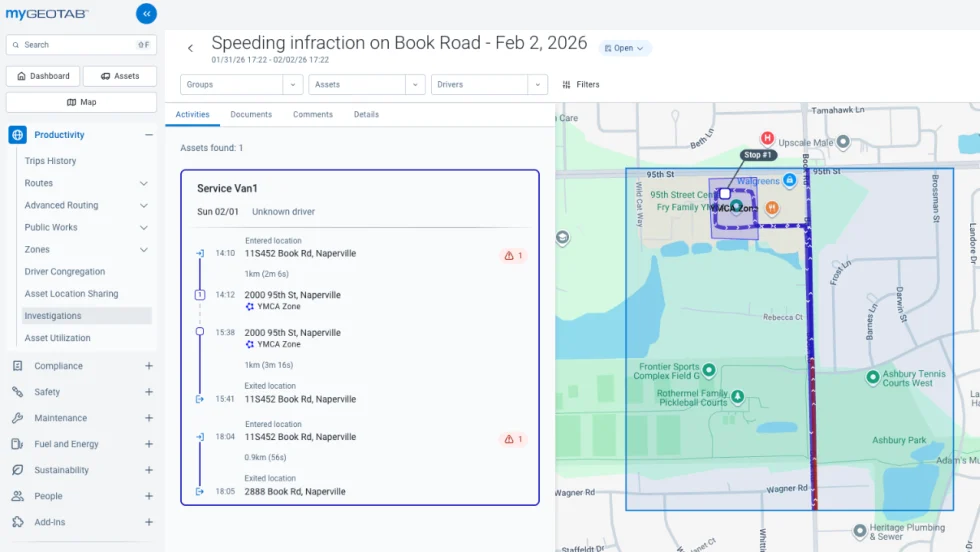
Geotab Adds Investigation Tools to Cut the Post-Incident Paper Chase
When a company vehicle is involved in a crash or complaint, Geotab Investigations brings telematics data, photos, reports, and other records into one case workflow.
Read More →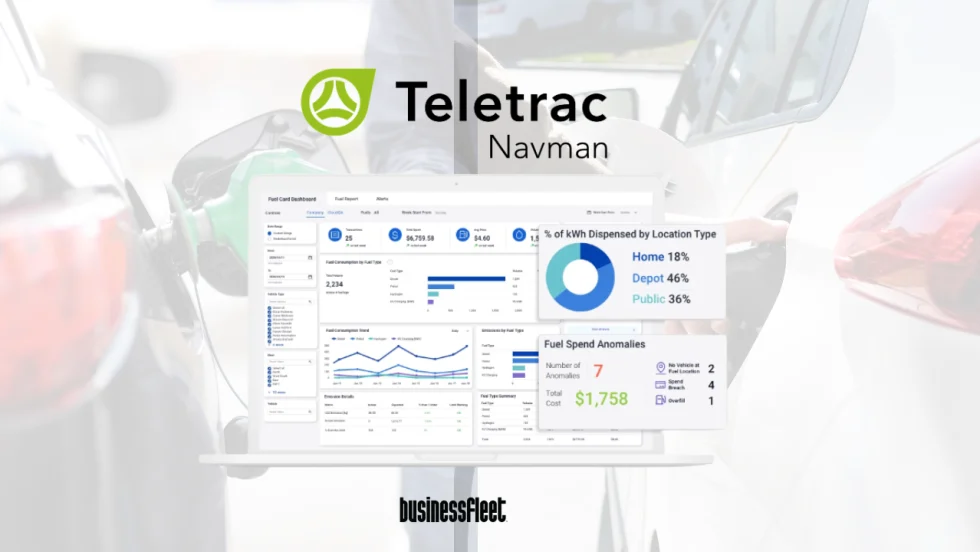
Teletrac Navman Adds Mixed-Energy Tracking to TN360
Energy Hub combines fuel card data, EV charging activity, reimbursements, and vehicle energy use in one dashboard for fleets operating gasoline, hybrid, and electric vehicles.
Read More →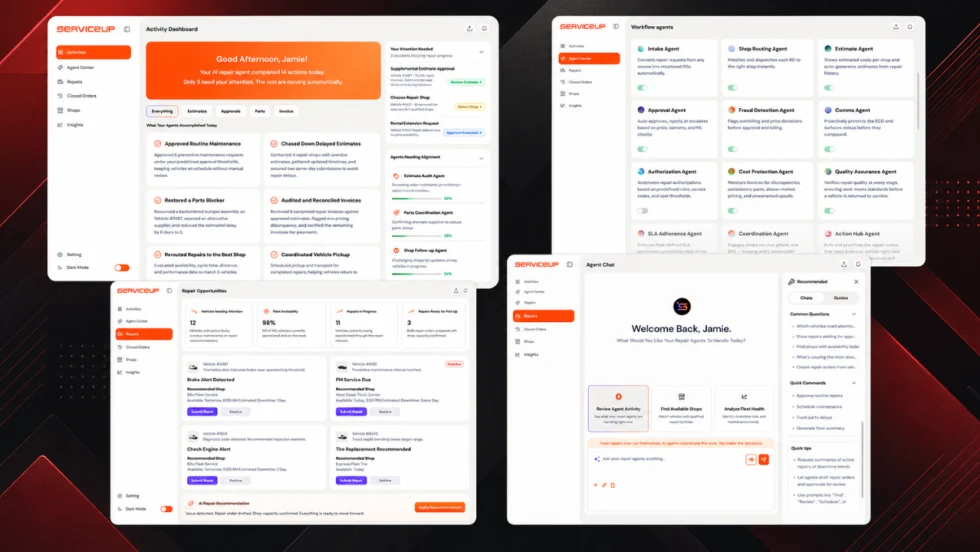
ServiceUp Brings Automated Repair Coordination to Small Fleet Operators
New AI repair agents handle shop calls, estimate reviews, status checks, and invoice validation so business owners can spend less time coordinating vehicle repairs.
Read More →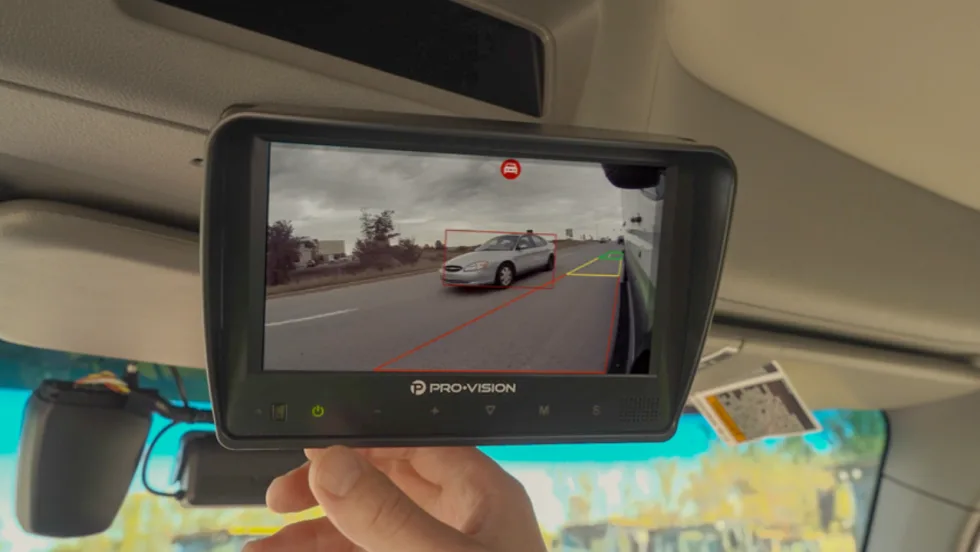
Pro-Vision Expands AI Fleet Safety Beyond the Cab
Pro-Vision's new AI camera and processing module extend real-time exterior hazard detection while integrating with leading fleet telematics platforms.
Read More →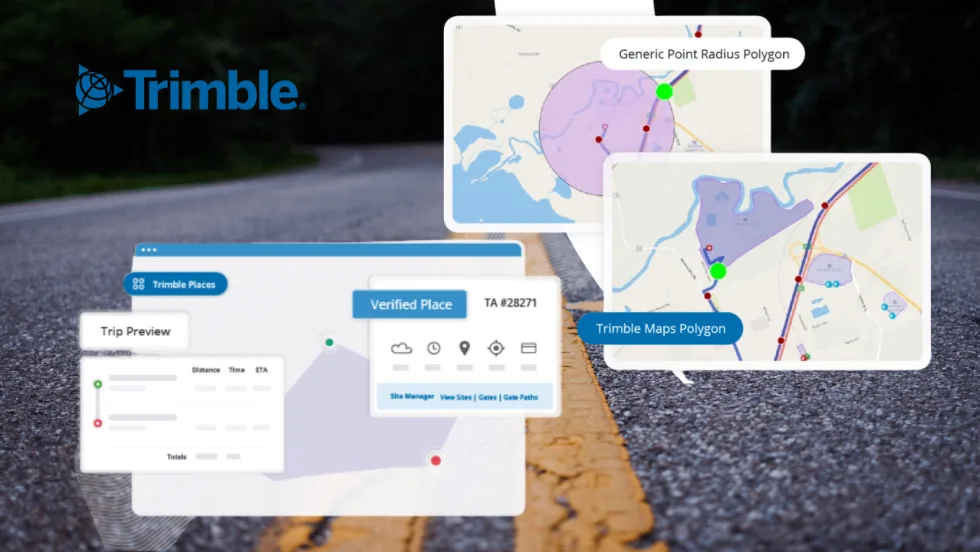
Trimble to Add Hotel Booking Capabilities to Fleet Products Through Engine Partnership
Trimble is adding hotel-booking capabilities to its fleet tools, helping drivers and small fleets find lodging faster during trips and breakdowns.
Read More →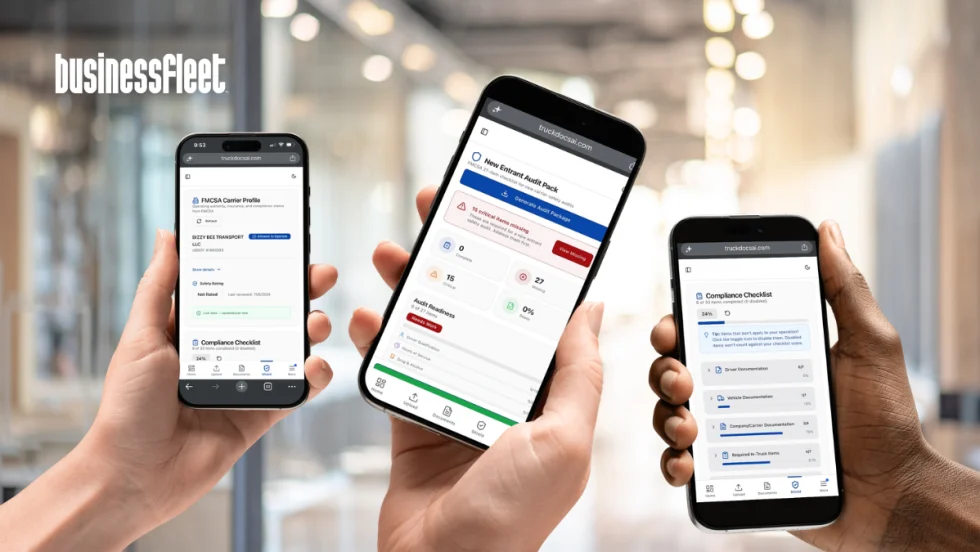
TruckDocsAI Launches AI-Powered Compliance Platform for Owner-Operators and Small Fleets
Can AI simplify DOT compliance? TruckDocsAI launches a new platform for owner-operators and small fleets facing audit pressures.
Read More →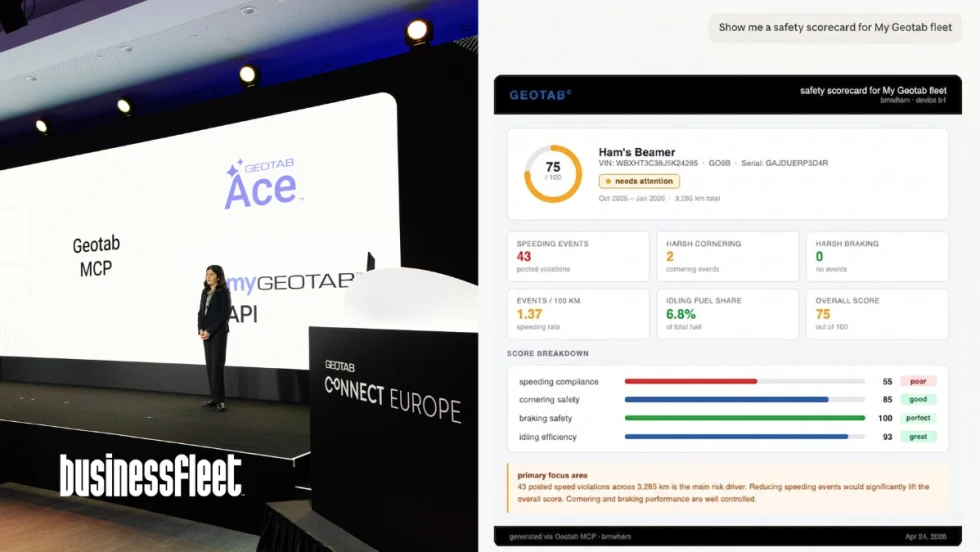
Geotab Says Fleet AI Success Depends More on Data Than the AI Model Itself
Geotab's new AI connector links fleet data with ChatGPT and other platforms, helping organizations turn AI investments into business results.
Read More →