



Interested in School Bus Fleets? Did you know we have a publication for that, too!? Check it out today!
Back-to-School Traffic Is Not the Risk Fleets Think It Is
Back-to-school traffic does not always mean more crashes. New Empiric Earth data shows why fleets should focus on when and where risk changes.
September 28, 2026

Back-to-school traffic does not affect every market the same way. Empiric Earth’s analysis found that collision rates rose in some cities and fell in others, giving fleets a reason to look closely at local routes, timing, and telematics data.
Credit:
Business Fleet
7 min to read
- Back-to-school traffic is not necessarily linked to an increase in crashes, contrary to common belief.
- Recent data from Empiric Earth highlights the importance of focusing on specific times and locations where risk levels vary.
- Fleets can optimize safety strategies by understanding and targeting these shifting risk patterns.
*Summarized by AI
Back-to-school traffic is easy to blame when roads suddenly feel busier, slower, and less predictable. More buses stop, parents line up outside schools, students cross streets, and regular commuting patterns shift almost overnight.
But more vehicles on the road do not automatically mean more collisions. An analysis from Empiric Earth, formed from a merger of Nexar and Nauto, found sharply different safety patterns across six U.S. cities when comparing the week before school started with the first full week students were back in class. And once the company normalized collisions by the number of rides instead of looking only at raw collision totals, the picture changed considerably.
Chicago's collision rate fell 19%, Atlanta's dropped 59%, Jacksonville's fell 54%, and Los Angeles declined 7%. Denver and New York were the only two markets in the analysis where collision rates increased, rising 46% and 21%, respectively.
"Rate is the only honest way to read this," said Rui Carneiro, Business Intelligence Lead at Empiric Earth. "Raw counts move with traffic volume, so a market can look worse simply because more people are driving. Normalizing per ride tells you whether the road actually got more dangerous."
For commercial fleets, that distinction matters. The question is not simply whether roads get busier when school starts. It is where the risk appears, when it peaks, and whether fleet managers can adjust routes or schedules before those conflict points become collisions.
New York Shows Why Near Misses Do Not Tell the Whole Story
One of the more interesting findings came from New York, where hard-braking events fell 2% while the collision rate increased 21%. Hard braking is commonly used as an indicator of potential risk or near-miss activity. But Carneiro said the New York results suggest there are situations where hazards may develop too quickly for braking behavior alone to capture the problem.
"When braking drops and collisions climb, the hazard arrives faster than the driver can react to it," he said.
Carneiro believes density may help explain it. On crowded streets, drivers have less space to maneuver and shorter sightlines when a hazard develops. That could mean a pedestrian emerging from between parked vehicles, a bus reentering traffic, or a queue suddenly extending into an intersection.
"That's a proximity problem, not a driver behavior problem, and coaching doesn't solve it," Carneiro said. "Route and schedule changes do."
That distinction is especially relevant for work truck fleets. Driver coaching remains important, but fleets running service calls, deliveries, utility work, or other scheduled stops can also reduce exposure by changing when a vehicle enters a high-risk area.
Jacksonville Shows Busier Does Not Always Mean More Dangerous
Jacksonville moved in the opposite direction. Driving volume increased approximately 8%, but its collision rate fell 54%, while hard-braking rates remained relatively unchanged.
Carneiro said Empiric Earth has seen similar patterns in other analyses. When traffic rises above its recent norm, average speeds may fall because of congestion while drivers also become more alert to the changing environment.
"Both reduce the odds of a serious impact," he said. "Busier does not automatically mean more dangerous."
The hourly data in Jacksonville provides another clue. Hard-braking activity spiked at approximately 3 p.m., around school dismissal, but that hour produced no collisions. The three collisions recorded during the study period occurred around 6 a.m., 11 a.m., and 6 p.m., rather than during the school dismissal period.
"Drivers slowed in the right place and the near-misses never converted," Carneiro said.
Jacksonville's road layout may also have helped. Carneiro pointed to wider arterials, dispersed schools, and a suburban road network that can provide drivers with additional space and visibility.
There is an important limitation, however. Jacksonville's collision count moved from six to three events. Carneiro cautioned against building a major safety strategy around the 54% figure alone because the sample is small. The same warning applies to Atlanta and Denver, which recorded only three to seven collisions in a week.
"Directionally, our study is correct, but there is a large error bar on magnitude," Carneiro said.
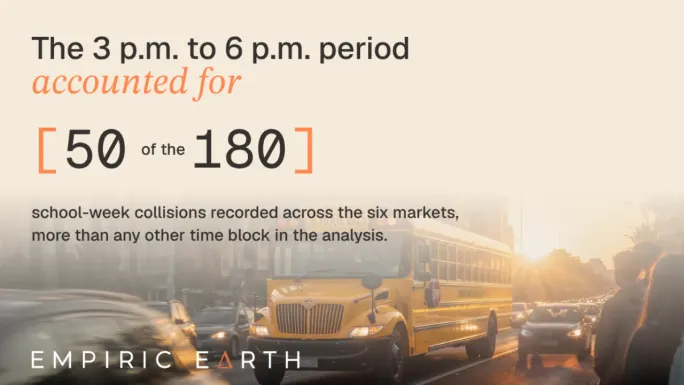
The 3 p.m. to 6 p.m. period accounted for more school-week collisions than any other time block in Empiric Earth’s six-market analysis, highlighting the afternoon as an important window for fleets to watch.
Credit:
Empiric Earth
The Afternoon Is the Window Fleets Should Watch
For fleets looking for one finding they can immediately use, Carneiro pointed to time of day. The 3 p.m. to 6 p.m. period accounted for 50 of the 181 school-week collisions recorded across the six markets, more than any other time block in the analysis.
New York reached its highest level of hard braking at 4 p.m., with 399 events, approximately 53% higher than its 7 a.m. rush-hour level. In Chicago, hard-braking activity at 2 p.m. exceeded the city's 8 a.m. level.
"Afternoon beats morning consistently," Carneiro said. "Pick-up queues are messier than drop-off queues, buses are loading rather than unloading, and student movement is less supervised at the end of the day."
Empiric Earth did not complete a spatial analysis identifying specific road types or intersections, so Carneiro cautioned against drawing conclusions about individual locations from the study. The timing data, however, gives fleets something they can work with.
"If an afternoon stop sits within half a mile of a school and isn't time-constrained, move it before 2 p.m. or after 5," he said. "In Los Angeles, after 6:30."
That kind of scheduling adjustment may be particularly realistic for service and vocational fleets, where some customer visits, inspections, maintenance work, or deliveries can be shifted without materially affecting the workday.
Three Indicators Small Fleets Can Watch
A fleet does not need a full-time safety department or sophisticated analytics team to look for changes when school resumes. Carneiro recommended watching three indicators already available through many basic telematics systems.
The first is hard braking between approximately 2 p.m. and 5 p.m. Rather than comparing drivers against one another, he recommends comparing each driver's performance with that driver's own baseline from July.
"A driver whose afternoon rate doubles is worth a conversation, not a warning," he said.
The second is trip duration. Longer trips by themselves are not necessarily a negative sign. Jacksonville's trip duration increased approximately 4% while safety improved, while Denver's increased nearly 8% as its collision rate worsened.
The combination matters more than either measurement alone. Rising trip duration paired with increasing hard-braking activity may deserve closer attention. The third period to watch is the very beginning of the school year.
"Across every city the first two days of the school week were the most volatile," Carneiro said.
Rather than immediately treating unusual telematics events as driver-performance problems, fleet managers can use those first few days to ask drivers what changed on their routes. A new school queue, altered traffic signal, bus stop, crossing guard, or parent drop-off pattern may reveal a new conflict point that a fleet manager sitting in an office would never see.
Preparing Before School Starts Next Year
Carneiro recommends fleets start preparing before the first school bus rolls rather than waiting for telematics alerts to appear. One option is a short driver briefing during the two weeks before local schools reopen. The discussion can identify actual school start dates, bus stops on frequently traveled routes, and school zones drivers are likely to encounter.
Carneiro recommends emphasizing additional following distance and awareness during the 7:30 to 8:30 a.m. and 2:30 to 4:30 p.m. periods.
"Adaptation risk is front-loaded," he said. "It shows up in the first two or three days and then resolves, so one briefing is the right tool for it."
Scheduling can also play a role. Empiric Earth's data suggests fleets should consider moving non-urgent work outside the 3 p.m. to 5 p.m. period during the early school year when practical.
Unlike the initial adjustment that happens when schools first reopen, Carneiro said the afternoon risk pattern persisted. The final step may be the most important: use your own fleet's data.
"Every city behaved differently, so a protocol built for New York is wrong for Jacksonville," Carneiro said.
He recommends reviewing the previous August or September's telematics data and identifying three to five road segments where hard-braking activity increased significantly once school resumed. Those locations can then be flagged for drivers before the next school year.
That may ultimately be the bigger lesson from the Empiric Earth analysis. There is no single back-to-school traffic pattern that applies everywhere. More traffic can mean slower speeds. More braking can mean drivers are successfully responding to changing conditions. And fewer braking events do not necessarily mean a route has become safer.
For small business fleets, the opportunity is to look beyond the dashboard total and understand what is changing around the vehicle. As Carneiro put it, these findings are not guarantees. They are signals that can help fleets determine where to look next.
Quick Answers
According to new data from Empiric Earth, back-to-school traffic does not necessarily lead to an increase in crashes.
*Summarized by AI
More Safety
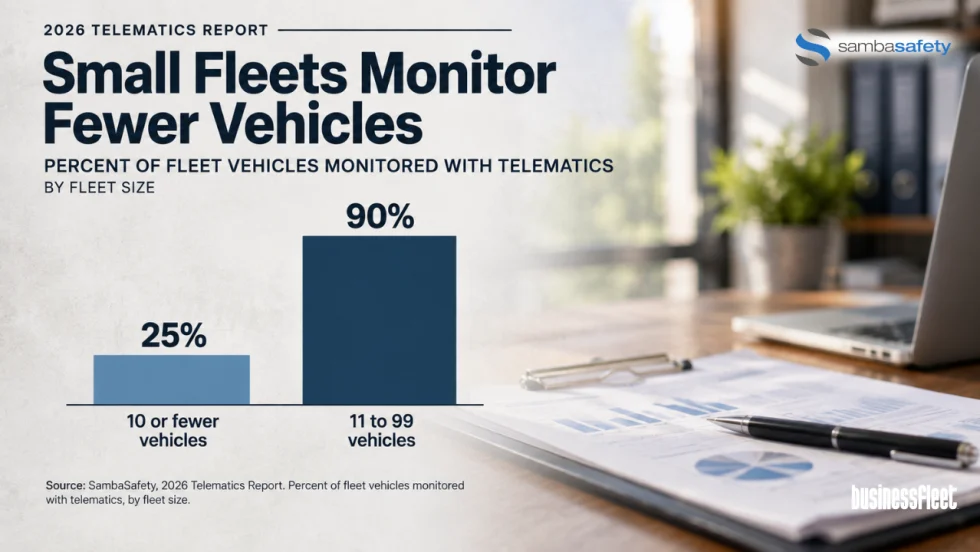
Small Fleets Lag in Telematics Coverage as Industry Moves Beyond Adoption
SambaSafety’s 2026 Telematics Report finds fleets with 10 or fewer vehicles monitor a much smaller share of their vehicles than larger operations, as the industry shifts its focus from collecting data to using it.
Read More →
Small Fleet, Big Exposure: How to Reduce Workers’ Comp Risks
For small fleets, one crash can trigger far more than vehicle damage. Here’s how stronger driver safety policies, training, maintenance, and technology can help reduce workers’ comp exposure.
Read More →
Who Makes the Call When Winter Weather Gets Dangerous?
Winter weather can quickly change a small fleet’s plans. Knowing when to reroute, delay, or stop can matter just as much as preparing the vehicles themselves.
Read More →
API Issues Refueling Safety Guidelines
The American Petroleum Institute offers a list of safe vehicle refueling guidelines, including ways to avoid potential problems with static electricity discharges in fall, winter, and early spring.
Read More →
Winter Fleet Prep: Expert Tips to Keep Vehicles Running Smoothly
Cold weather can expose weak batteries, tires, fuel systems, and maintenance gaps fast. Use this winter fleet checklist to prepare trucks and drivers before temperatures drop.
Read More →
8 ADAS Maintenance Tips for Small Business Fleets From Bendix
A dirty camera, bad alignment, or one loose connection could quietly knock your fleet’s ADAS offline. Here’s what Bendix says to check.
Read More →
Developing Budget-Friendly Driver Safety Programs
From driver training and safety meetings to one-on-one coaching and incentive programs, several small fleets share how they have developed a safety culture with their drivers using low- to no-cost resources.
Read More →
A 20-Minute Safety Check for Small Fleets Before Operation Safe Driver Week
No safety department? No problem. Here's a practical checklist small fleet managers can use before Operation Safe Driver Week begins.
Read More →
Why Small Fleets Keep Getting Tripped Up by ELD Compliance
Roadcheck revealed a hard truth: most ELD violations aren't intentional. They're caused by small mistakes that can cost fleets time, money, and trust.
Read More →
Before the Fireworks Start Small Fleets Should Review Their Cargo Security Plans
Long holiday weekends create prime conditions for cargo theft. Here's what small fleet operators should review before the Fourth of July.
Read More →Subscribe to Our Newsletter