


About the Author: Daren Hansen is a Sr. Compliance Expert – Transportation at J. J. Keller & Associates, Inc. This article was authored and edited following Business Fleet editorial standards and style. Opinions expressed may not reflect those of BF.
FMCSA Revokes 130+ ELDs: What Fleet Owners Need to Know
After FMCSA removed more than 130 ELDs from its registry, fleet owners need to check their devices, understand exemptions, and prepare for compliance deadlines.
by Daren Hansen, J. J. Keller & Associates, Inc.
November 20, 2026
Credit:
Business Fleet
5 min to read
The DOT is cracking down on noncompliant electronic logging devices (ELDs) like never before. The Federal Motor Carrier Safety Administration (FMCSA) recently revoked more than 130 of them all at once, some from major providers. That’s the largest one-day revocation in the agency's history, and a warning sign for all fleets.
If you use a revoked device, you’ll need to take immediate action. Even if you don’t, it’s time to take stock of your hours-of-service compliance program to confirm whether you need ELDs, ensure your ELD provider is compliant, verify your drivers’ records aren't being falsified (possibly without your knowledge), and make sure your fleet is ready for roadside inspections.
What to Do If Your ELD Has Been Revoked
The mass revocation landed on November 12, 2026, and included 121 devices revoked by the FMCSA and another 12 voluntarily removed by their providers. All were labeled noncompliant with the ELD standards.
For ELD-using fleets, this means taking immediate action. Don’t wait for an email from your provider.
- Review the official ELD list at eld.fmcsa.dot.gov/List and make sure your device is still registered. It’s a good idea to do this on a monthly basis.
- If your ELD is on the revoked list:
- Stop using the revoked device and switch to paper logs or logging software to record required hours-of-service information.
- Replace the revoked device with a compliant ELD from FMCSA's registered devices list before Jan. 12, 2027.
Act today, because ensuring compliance can involve a lot more than swapping hardware. It may take weeks to find a reputable provider, select and install replacement devices, create or migrate driver accounts, and train your drivers and administrators. The bigger the fleet, the harder those steps become.
If your drivers are forced to switch to paper (or digital) logs in the interim, be sure they’re prepared to explain why they’re (temporarily) no longer using an ELD.
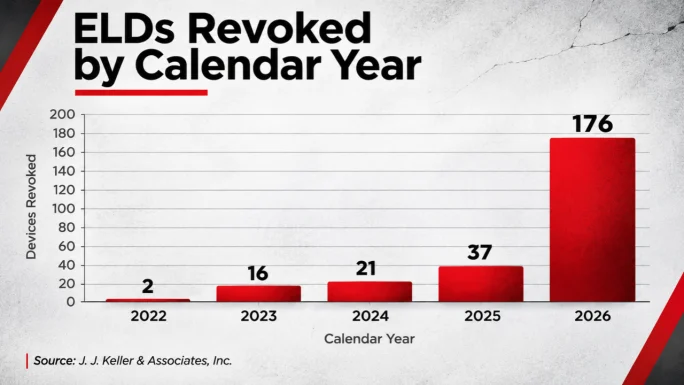
ELD revocations have climbed sharply in recent years, rising from just two devices in 2022 to 176 in 2026. With FMCSA increasing scrutiny of noncompliant devices, fleet owners should regularly check their ELD registration status and review their hours-of-service compliance programs.
Credit:
Business Fleet
Which Drivers Are Required to Use ELDs?
Don’t assume you need ELDs simply because you operate commercial motor vehicles (CMVs) but also don’t assume you’re exempt simply because you stay local or your drivers don’t have commercial driver’s licenses (CDLs).
Many small fleets ask, “Does this vehicle need an ELD?” but a better starting question is, “Does this driver need an ELD?” The federal ELD mandate generally applies when a driver operates a vehicle over 10,000 pounds across state lines and must prepare standard logs (records of duty status) on more than 8 days in any rolling 30 consecutive days. Such a driver must use an ELD in every regulated CMV they operate (excepting any pre-2000 vehicles or certain short-term rentals).
Small companies that stay close to home (think plumbing, HVAC, construction, landscaping, delivery, service, and similar fleets) can typically claim the 150-air-mile exception (see 49 CFR 395.1(e)), making them exempt from logs and ELDs — as long as the terms of the exception are complied with.
For fleets operating strictly within one state, ELD requirements can vary. Some states follow federal requirements, while others have different rules or exemptions for intrastate operations. Check with your state's commercial vehicle enforcement agency to determine whether your drivers need ELDs. In many states, only CDL-class vehicles are subject. Check with your state CMV enforcement agency or a compliance expert if you’re unsure.
How to Check If Your ELD Is Compliant
If you have ELDs, don’t assume they’re compliant just because they weren’t revoked. The FMCSA’s registered-device system relies on manufacturers to self-certify that their devices meet the rigorous technical specifications. The U.S. government does not test and approve ELDs before they reach the market.
This doesn’t mean you need to independently verify that your ELD system complies with the roughly 350 ELD technical specs. But in addition to checking the FMCSA’s list routinely, you should audit your drivers’ ELD records for signs of falsification.
If your drivers — either themselves or with help from the vendor — can shorten their driving time, fabricate rest, use a “ghost” or shared account, or travel at mathematically impossible speeds, your ELD’s software may be part of the problem. Work with your vendor to find a compliant solution or look elsewhere.
What ELD Violations Can Cost Your Fleet
Drivers found in violation of the ELD rules can be placed out of service and fined. This means the driver is sidelined until they’re using a compliant device, leading to a cascade of indirect costs:
- Trucks and drivers sitting while the compliance issue is resolved;
- Missed deliveries, service calls, or customer appointments;
- Expedited shipping and installation of new equipment;
- Driver and supervisor time spent learning a replacement system;
- Reconstructing or retrieving hours-of-service records;
- Administrative time dealing with vendors and roadside enforcement; and
- Longer-term audit and liability exposure if inaccurate or falsified records are discovered.
That’s why ELD compliance shouldn’t be viewed simply as a technology issue. Your logging system can affect whether your vehicles are available to make money.
What to Ask Before Choosing an ELD Provider
Price matters, but the cheapest ELD can become expensive very quickly if its provider can’t keep the device compliant. Look beyond the subscription costs and all the “bells and whistles.”
It’s the technical standards and customer support that really matter. Before selecting a new ELD, ask the provider:
- How do you test your ELD for compliance with FMCSA specifications?
- How are software and firmware updates tested before release?
- Do you have in-house compliance expertise?
- Do you have a proven track record of ELD compliance on the road and during audits?
- What support is available when a driver has a problem at 6 a.m. or during a roadside inspection?
- What happens when the FMCSA changes a requirement or identifies a problem? Do you have contingency plans?
- How will you notify me if my device’s registration status changes?
- What other features does your device offer besides ELD compliance?
- Can I export and preserve my drivers’ records if I change providers?
Ask hard questions about the company behind the technology. An established compliance process, reliable support, and rigorous testing deserve as much weight as price and features.
The FMCSA’s ongoing crackdown is a reminder that buying an ELD isn’t a one-time compliance decision. Installation is only the beginning. Check its status, audit the records it produces, and hold your provider accountable for keeping it compliant. A few minutes of prevention can save costly headaches later.

Credit:
Business Fleet | J.J. Keller
More Safety
Holiday Closures Can Leave Small Business Fleet Vehicles Vulnerable to Theft
Thanksgiving closures can leave business vehicles and cargo unattended. J. J. Keller shares practical steps to help fleets reduce theft risks.

Clocks Fall Back Nov. 1. Is Your Fleet Ready for Earlier Darkness?
Clocks fall back Nov. 1. Help your fleet prepare for earlier darkness with quick checks for driver visibility, schedules, fatigue, and seasonal road hazards.

Tips for Driving Safely on Halloween Night
This video features a reminder from the Connecticut Department of Transportation (DOT) and the Connecticut Police Chiefs Association, urging drivers to prioritize safety this Halloween.

Mercedes Benz Tests CLA Occupant and Battery Protection in Side Impact Crash
Two CLA sedans traveling at 35 mph were used in a Mercedes-Benz crash test examining occupant protection and electric vehicle battery safety.
How Technology Can Help Fleet Owners Improve Insurability
Your fleet's telematics data could be the difference between getting insurance coverage and facing higher premiums or non-renewal. Here's what insurers are looking for and how fleets can use that data to make a stronger case at renewal.
Simple Tire Checks That Help Keep Your Business Fleet Moving
A survey found that nearly one in every 10 passenger vehicles has at least one bald tire. What's more, 27% -- more than one in four -- of vehicles are driven with one or more severely under-inflated tires.
Small Fleets Lag in Telematics Coverage as Industry Moves Beyond Adoption
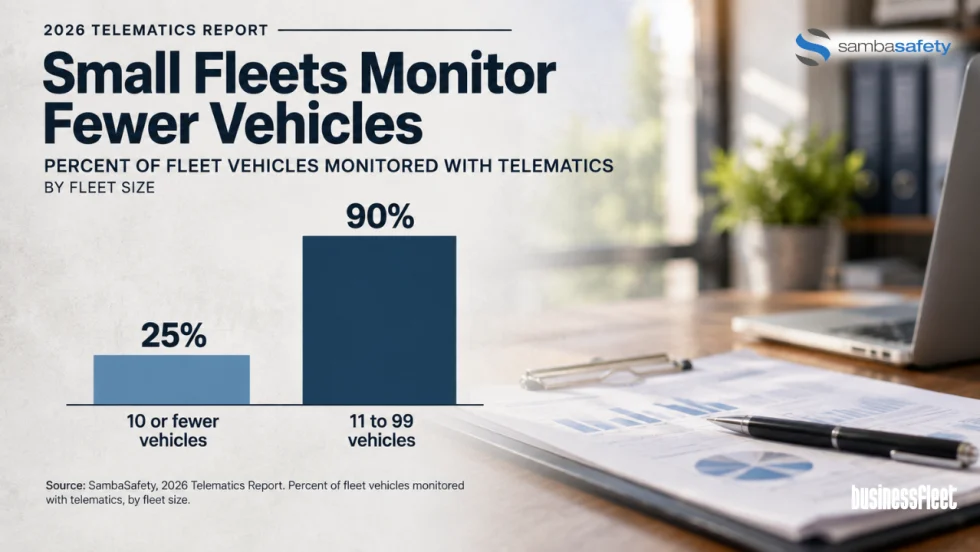
SambaSafety’s 2026 Telematics Report finds fleets with 10 or fewer vehicles monitor a much smaller share of their vehicles than larger operations, as the industry shifts its focus from collecting data to using it.

Back-to-School Traffic Is Not the Risk Fleets Think It Is
Back-to-school traffic does not always mean more crashes. New Empiric Earth data shows why fleets should focus on when and where risk changes.
Small Fleet, Big Exposure: How to Reduce Workers’ Comp Risks
For small fleets, one crash can trigger far more than vehicle damage. Here’s how stronger driver safety policies, training, maintenance, and technology can help reduce workers’ comp exposure.

Who Makes the Call When Winter Weather Gets Dangerous?
Winter weather can quickly change a small fleet’s plans. Knowing when to reroute, delay, or stop can matter just as much as preparing the vehicles themselves.
Subscribe to Our Newsletter