


Safety Near Bicyclists [Video Safety Tip]
Here's some advice, provided by AAA and the Palmetto Cycling Coalition, to help motorists share the road safely with cyclists.

![Safety Near Bicyclists [Video Safety Tip]](https://assets.bobitstudios.com/image/upload/f_auto,q_auto,dpr_auto,c_limit,w_920/Screen-Shot-2015-08-30-at-11-37-23-AM_1776047013634_vnqutq.png)
Photo: AAA
Many major cities are looking for ways to promote cycling, adding bicycle lanes and paths in congested business districts as well as residential areas. The hope is that cycling will continue to become a bigger part of the transportation system, expanding well beyond its role as a recreational pastime and sport.
But the relationship between cyclists and motorists can, as we all know, become strained.
Here are some safety tips from the Palmetto Cycling Coalition that you may want to pass along to fleet drivers to help promote a safer coexistence.
Drive Cautiously
Reduce speed when encountering cyclists.
In inclement weather, give cyclists extra trailing and passing room.
Recognize situations that may be potentially dangerous to cyclists and give them space.
Yield to cyclists
Cyclists are considered vehicles and should be given the appropriate right of way.
Cyclists may take the entire lane when hazards, road width or traffic speed dictate.
Motorists should allow extra time for cyclists to traverse intersections.
Be considerate
Scan for cyclists in traffic and at intersections.
Do not blast your horn in close proximity to cyclists.
Look for cyclists when opening doors.
Pass with care
Leave at least three feet of space between your car and a cyclist when passing.
Wait until road and traffic conditions allow you to safely pass.
Check over your shoulder after passing a cyclist before moving back to your normal position.
Watch for children and keep in mind:
Children on bicycles are often unpredictable – expect the unexpected and slow down.
Most children don’t have adequate knowledge of traffic laws.
Children are harder to see because they are typically smaller than adults.
Originally posted on Automotive Fleet
More Safety
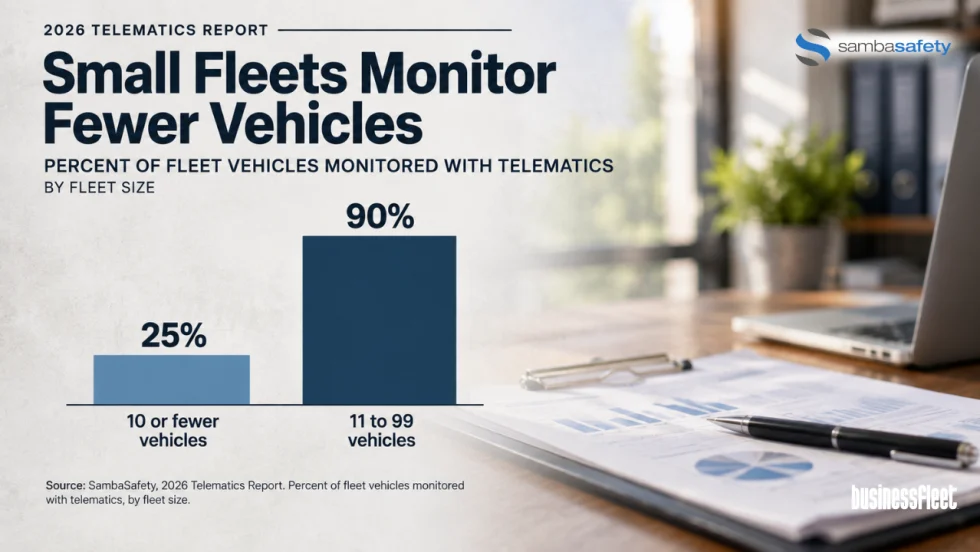
Small Fleets Lag in Telematics Coverage as Industry Moves Beyond Adoption
SambaSafety’s 2026 Telematics Report finds fleets with 10 or fewer vehicles monitor a much smaller share of their vehicles than larger operations, as the industry shifts its focus from collecting data to using it.
Read More →
Back-to-School Traffic Is Not the Risk Fleets Think It Is
Back-to-school traffic does not always mean more crashes. New Empiric Earth data shows why fleets should focus on when and where risk changes.
Read More →
Small Fleet, Big Exposure: How to Reduce Workers’ Comp Risks
For small fleets, one crash can trigger far more than vehicle damage. Here’s how stronger driver safety policies, training, maintenance, and technology can help reduce workers’ comp exposure.
Read More →
Who Makes the Call When Winter Weather Gets Dangerous?
Winter weather can quickly change a small fleet’s plans. Knowing when to reroute, delay, or stop can matter just as much as preparing the vehicles themselves.
Read More →
API Issues Refueling Safety Guidelines
The American Petroleum Institute offers a list of safe vehicle refueling guidelines, including ways to avoid potential problems with static electricity discharges in fall, winter, and early spring.
Read More →
Winter Fleet Prep: Expert Tips to Keep Vehicles Running Smoothly
Cold weather can expose weak batteries, tires, fuel systems, and maintenance gaps fast. Use this winter fleet checklist to prepare trucks and drivers before temperatures drop.
Read More →
8 ADAS Maintenance Tips for Small Business Fleets From Bendix
A dirty camera, bad alignment, or one loose connection could quietly knock your fleet’s ADAS offline. Here’s what Bendix says to check.
Read More →
Developing Budget-Friendly Driver Safety Programs
From driver training and safety meetings to one-on-one coaching and incentive programs, several small fleets share how they have developed a safety culture with their drivers using low- to no-cost resources.
Read More →
A 20-Minute Safety Check for Small Fleets Before Operation Safe Driver Week
No safety department? No problem. Here's a practical checklist small fleet managers can use before Operation Safe Driver Week begins.
Read More →
Why Small Fleets Keep Getting Tripped Up by ELD Compliance
Roadcheck revealed a hard truth: most ELD violations aren't intentional. They're caused by small mistakes that can cost fleets time, money, and trust.
Read More →