


Acura TL, Volvo S60 Draw Top Ratings in New IIHS Frontal Crash Test
In the newly developed small overlap frontal crash test, 25% of a car's front end on the driver side strikes a 5-foot-tall rigid barrier at 40 mph.

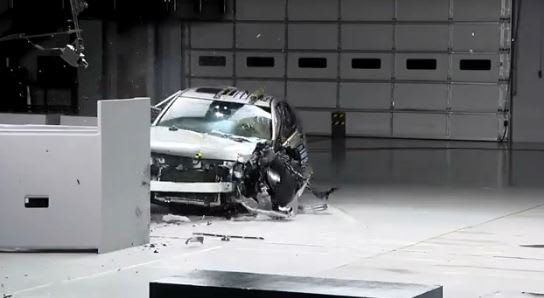
Of the 11 midsize luxury and near-luxury vehicles that the Insurance Institute for Highway Safety recently subjected to its new small overlap frontal crash test, only the Acura TL and Volvo S60 drew the group’s highest rating of “good,” IIHS said. All the tested vehicles were 2012 models.
In the newly developed small overlap frontal crash test, 25% of a car's front end on the driver side strikes a 5-foot-tall rigid barrier at 40 mph. A 50th percentile male Hybrid III dummy is belted in the driver seat. The test is designed to replicate what happens when the front corner of a car collides with another vehicle or an object like a tree or utility pole. Outside of some automakers' proving grounds, such a test isn't currently conducted anywhere else in the United States or Europe, the IIHS said.
"Nearly every new car performs well in other frontal crash tests conducted by the Institute and the federal government, but we still see more than 10,000 deaths in frontal crashes each year," Institute President Adrian Lund said. "Small overlap crashes are a major source of these fatalities. This new test program is based on years of analyzing real-world frontal crashes and then replicating them in our crash test facility to determine how people are being seriously injured and how cars can be designed to protect them better. We think this is the next step in improving frontal crash protection."
In NHTSA's frontal test, passenger vehicles crash at 35 mph into a rigid barrier covering the full width of the vehicle. In IIHS’s 40 mph offset frontal test, now called a moderate overlap frontal test, 40% of the total width of a vehicle strikes a deformable barrier on the driver side.
In a 2009 IIHS study of vehicles with “good” ratings for frontal crash protection, small overlap crashes accounted for nearly a quarter of the frontal crashes involving serious or fatal injury to front seat occupants. Another 24% of the frontal crashes were moderate overlap crashes, although they likely occurred at much higher speeds than the IIHS moderate overlap test. An additional 14% occurred when passenger vehicles under-rode large trucks, SUVs or other high-riding passenger vehicles.
The IIHS said it is exploring countermeasures for large truck under-ride crashes, and other research has found that the problem of crash incompatibility between cars and SUVs is being reduced.
The key to protection in any crash is a strong safety cage that resists deformation to maintain survival space for occupants. Then vehicle restraint systems can do their jobs to cushion and protect people.
"It's Packaging 101. If you ship a fragile item in a strong box, it's more likely to arrive at its destination without breaking,” Lund said. “In crashes, people are less vulnerable to injury if the occupant compartment remains intact."
Most modern cars have safety cages built to withstand head-on collisions and moderate overlap frontal crashes with little deformation. At the same time, crush zones help manage crash energy to reduce forces on the occupant compartment, the IIHS said. The main crush-zone structures are concentrated in the middle 50% of the front end. When a crash involves these structures, the occupant compartment is protected from intrusion, and front airbags and safety belts can effectively restrain and protect occupants.
But small overlap crashes are a different story, the IIHS said. These crashes primarily affect a car's outer edges, which aren't well protected by the crush-zone structures. Crash forces go directly into the front wheel, suspension system and firewall. It is not uncommon for the wheel to be forced rearward into the footwell, contributing to even more intrusion in the occupant compartment and resulting in serious leg and foot injuries.
To provide effective protection in small overlap crashes, the safety cage needs to resist crash forces that aren't tempered by crush-zone structures. Widening these front-end structures also would help, according to the IIHS.
"These are severe crashes, and our new test reflects that," Lund said. "Most automakers design their vehicles to ace our moderate overlap frontal test and NHTSA's full-width frontal test, but the problem of small overlap crashes hasn't been addressed. We hope our new rating program will change that."
Luxury and near-luxury cars were the first to undergo the test because these models typically get advanced safety features sooner than other vehicles, Lund said.
Structurally, the Volvo S60 was best, IIHS said. With only a few inches of intrusion, the occupant compartment looked much the same as it did in a moderate overlap test. Reinforcement of the S60's upper rails and a steel cross member below the instrument panel helped to keep the safety cage intact. Volvo has performed similar small overlap tests as part of its vehicle safety development process since the late 1980s, taking the results into account when designing new models.
See below an IIHS video about the test.
Originally posted on Work Truck Online
More Safety

Small Fleets Lag in Telematics Coverage as Industry Moves Beyond Adoption
SambaSafety’s 2026 Telematics Report finds fleets with 10 or fewer vehicles monitor a much smaller share of their vehicles than larger operations, as the industry shifts its focus from collecting data to using it.
Read More →
Back-to-School Traffic Is Not the Risk Fleets Think It Is
Back-to-school traffic does not always mean more crashes. New Empiric Earth data shows why fleets should focus on when and where risk changes.
Read More →
Small Fleet, Big Exposure: How to Reduce Workers’ Comp Risks
For small fleets, one crash can trigger far more than vehicle damage. Here’s how stronger driver safety policies, training, maintenance, and technology can help reduce workers’ comp exposure.
Read More →
Who Makes the Call When Winter Weather Gets Dangerous?
Winter weather can quickly change a small fleet’s plans. Knowing when to reroute, delay, or stop can matter just as much as preparing the vehicles themselves.
Read More →
API Issues Refueling Safety Guidelines
The American Petroleum Institute offers a list of safe vehicle refueling guidelines, including ways to avoid potential problems with static electricity discharges in fall, winter, and early spring.
Read More →
Winter Fleet Prep: Expert Tips to Keep Vehicles Running Smoothly
Cold weather can expose weak batteries, tires, fuel systems, and maintenance gaps fast. Use this winter fleet checklist to prepare trucks and drivers before temperatures drop.
Read More →
8 ADAS Maintenance Tips for Small Business Fleets From Bendix
A dirty camera, bad alignment, or one loose connection could quietly knock your fleet’s ADAS offline. Here’s what Bendix says to check.
Read More →
Developing Budget-Friendly Driver Safety Programs
From driver training and safety meetings to one-on-one coaching and incentive programs, several small fleets share how they have developed a safety culture with their drivers using low- to no-cost resources.
Read More →
A 20-Minute Safety Check for Small Fleets Before Operation Safe Driver Week
No safety department? No problem. Here's a practical checklist small fleet managers can use before Operation Safe Driver Week begins.
Read More →
Why Small Fleets Keep Getting Tripped Up by ELD Compliance
Roadcheck revealed a hard truth: most ELD violations aren't intentional. They're caused by small mistakes that can cost fleets time, money, and trust.
Read More →